
The White House is requesting that the United States Congress increase the U.S. defense budget to $1.5 trillion (£1.1 trillion), marking the largest expansion in military spending since World War II.
The proposed budget includes funding for the “Golden Dome” missile defense system put forward by Donald Trump, as well as increased domestic production of naval vessels, including new heavily armed warships.
The administration stated that the spending increase would be accompanied by cuts to domestic agencies, including reductions or eliminations of programs related to climate, housing, and education.
This proposal—subject to approval by Congress—is separate from the $200 billion requested by the Pentagon for operations related to the conflict with Iran.
An online budget summary highlights that savings would come from “reducing or eliminating unnecessary, politicized, and wasteful programs,” while shifting certain responsibilities back to state governments.
Trump has long advocated for increased defense spending and strengthening domestic military production. At a recent White House event, he emphasized that military defense should become a national priority, suggesting that social programs could be managed at the state level.
Non-defense spending in the proposal has been reduced by approximately 10%, or about $73 billion.
The proposed budget represents a 42% increase compared to the previous fiscal year, with discretionary Pentagon spending reaching around $1.1 trillion—the highest level on record.
An additional $350 billion designated for the defense industrial base would be secured through “budget reconciliation,” a legislative process allowing passage in the Senate with a simple majority of 51 votes.
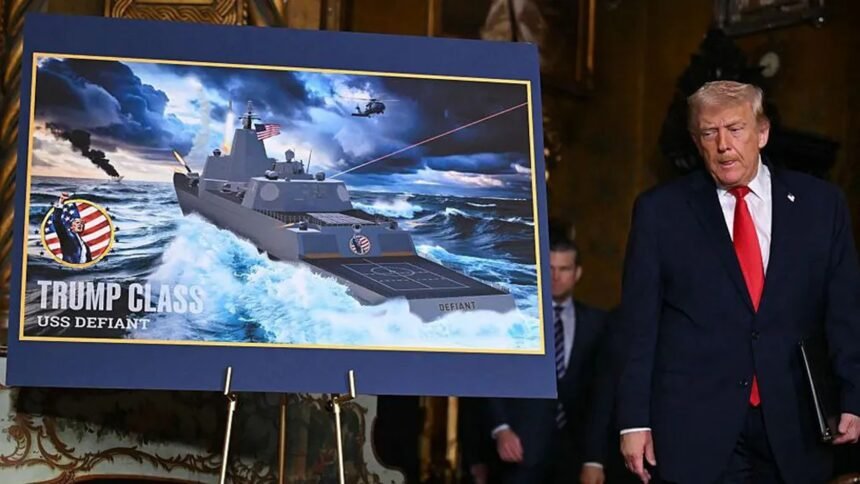
The plan also includes pay raises for troops and $65.8 billion allocated for shipbuilding, including what Trump has referred to as the “Golden Fleet” of next-generation vessels.
These include heavily armed warships, with construction of the first vessel, USS Defiant, expected to begin soon, and initial ships projected to become operational within two and a half years.
U.S. officials have repeatedly warned that the country is currently lagging behind China in both shipbuilding capacity and overall production.
Additionally, the budget includes an estimated $185 billion for the Golden Dome system, which would involve multiple layers of sensors and interceptors across land, sea, and space to defend against next-generation missiles and drones.
However, the Congressional Budget Office has estimated that space-based components alone could cost up to $542 billion over 20 years, raising concerns among experts that total costs could consume a significant portion of the overall defense budget.