“Žetva” (Harvest) is the title in Serbian of Serbia’s new propaganda film.
With substantial state support and promotion, attendees at the premiere saw what the production itself describes as a “shocking story of a German baron in need of a heart transplant.” As seen in the trailer and in various descriptions of the film, it is Kosovo Albanians who provide the baron with a Serbian heart. The German is now overcome because, having a Serbian heart, it beats strongly for Kosovo. In this film, according to even some Serbian critics, there is no trace of art. For Kosovo artists, it is simply a project in the service of propaganda.
Serbian institutions continue to work at what they do best: propaganda. These days, the premiere of the film “Žetva,” in English “Harvest” and in Albanian “Korrje,” took place. The political and artistic elite gathered to open an exhibition titled “Žuta kuća – zločin bez presude” (The Yellow House, an Unpunished Crime). All together in the “MTS” hall in Belgrade, when they watched the film, they learned much about what the production itself describes as a “shocking story of a German baron in need of a heart transplant.” As seen in the trailer and descriptions of the film, it is Kosovo Albanians who provide the baron with a Serbian heart. The German is now overcome because, having a Serbian heart, it beats strongly for Kosovo. In this film, according to some Serbian critics, there is no trace of art. For Kosovo artists, it is just a propaganda project.
Serbia has promoted the story of organ trafficking everywhere, also with Russian support. It reached a report in the Council of Europe. Based on that report, the Kosovo Specialist Chambers in The Hague, also known as the Special Court, now operate. Intensive international investigations have been conducted on the ground, and in the indictments filed, the word “organs” or “transplant” is never mentioned. But in Serbian films, it appears.
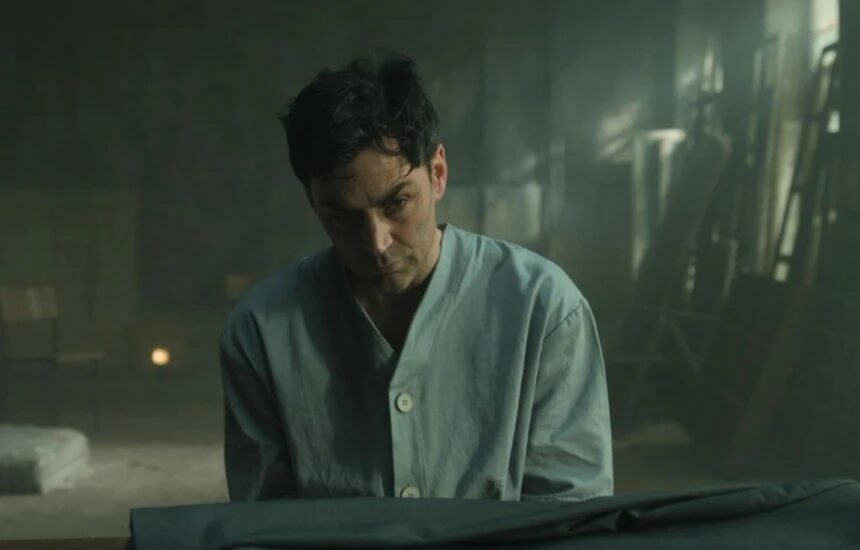
To make the film more credible on the international stage, an American director was found. Paul Kampf, without any notable career in cinema, took on a two-year project to visualize the novel “The Serbian Heart of Johanovos” by Serbian writer Veselin Dzheletović. With a cast of international and Serbian actors, the film tells a story where the German baron, Johann von Wagner portrayed by Matthew McNulty, a British actor of German origin needs a heart transplant. He finds this possibility at the end of the last century when Albanians sell him a Serbian heart. In 1999, when the story in the film begins, Serbia intensified the war in Kosovo. Between 1998 and 1999, over 10,000 Albanian civilians were killed during the ethnic cleansing that the Serbian state carried out against Albanians. For this reason, in March 1999, the democratic world intervened and launched NATO’s air campaign against the Yugoslav-Serbian army targets to stop the ethnic cleansing and crimes against humanity. But in Veselin Dzheletović’s novel and in the film adapted from it with Paul Kampf’s script, the problem is the German who Albanians supposedly allow to have a Serbian heart, and allegedly, there existed a “Yellow House” where these crimes were committed. The film premiered in Belgrade on March 17, gathering around 11,000 viewers in Serbian cinemas during the first week.
At the state-organized premiere, the President of the National Assembly of Serbia, Ana Brnabić, and the Minister of Culture, Nikola Selaković, were present. The author of the novel on which the story is based and co-writer of the film, Veselin Dzheletović, stated to the news agency “Tanjug” that he is extremely pleased with the film adaptation. He declared that he feels great pride that the story reached an American director, although he initially had reservations. But he did not stop there.
“The producer convinced me, while decisive was the fact that the directors sent agents to Kosovo and Metohija to verify the claims from the novel. Only after they were convinced that everything is true, they agreed to work on the film. Paul Kampf did not withdraw even after thousands of threatening emails from the Albanian lobby. Some actors withdrew despite contracts, but the truth is like water; it always finds its way,” he said. The co-director of the film is Mladen Shević, and the director of photography is Radan Popović. In the main roles, besides Matthew McNulty, are Paul Murray, Rebecca Calder, and Serbian actors Jovana Gavrilović, Miodrag Dragičević, and Radoje Čupić.
Intensive international investigations on the ground have not found a “Yellow House” where Albanians transplanted the organs of Serbs. But in Serbian films, the situation is different.
For literary and film critic Đorđe Bajić, the film does not meet expectations, and according to him, “the heart was transplanted but it did not beat.” In an article analyzing the film for “Vreme,” he views the entire project as a missed opportunity. According to him, “Harvest,” which may have had a political purpose and weight, failed to find a convincing and artistically valid way to convey it.
“In short, ‘Harvest’ is a film without which we could have done, and for which money was spent that could have been used elsewhere for a more useful purpose. The failure of this ‘nationally important project’ is evident on several levels. It is not the worst film in the world, let’s not exaggerate; it has some viewership and Matthew McNulty in the lead role fights heroically with the limitations of the script, but overall: the impression is very weak. What worries me is the obvious propagandistic note (which, let’s be honest, was expected), but even more so the fact that fundamentally it is a film for which it is hard to explain why it exists, who it addresses, and what it truly aims to achieve,” writes Bajić. According to him, the ambition is visible in the premise where the film tries to combine a personal, almost metaphysical story about identity and guilt with a politically and historically difficult topic.
“The problem is that these two layers never organically connect. Instead of a complex drama, we get an illustrative narrative that insists more on the message than on cinematic expression. If the idea was to present ‘our story’ to an international audience—which is clear from the international cast (Matthew McNulty, Angus McFayden, and others), the decision to have most of the film in English and with foreign collaborators—paradoxically, the result is not convincing enough for that audience,” he writes. He does not see it worthy of any “A”-category festival. In reality, the film has so far been shown at a festival that does not belong to this category, such as the Beloit International Film Festival in Wisconsin, USA, and has not won any awards.
According to critic Bajić, the film lacks many things, but above all, the main role fails to develop a full and psychologically credible character.
“In conclusion, ‘Harvest’ is a film with obvious ambition and a ‘big theme,’ but without appropriate cinematic expression. It gives the impression of a missed opportunity—a project that may have had a political purpose and weight but did not find a convincing and artistically valid way to convey it. The heart was transplanted, but it did not beat,” writes Bajić.
Kosovo actor Armend Baloku, who has lived in New York in recent years, reacted, saying that Serbia, through director Paul Kampf, made the film “Harvest,” which deals with the so-called “Yellow House.”
“While we continue to deal with entirely superficial issues, Serbia is seriously investing in criminalizing the KLA’s war through cinema. This, in a broader context, becomes even more concerning when considering its armament and geopolitical changes in the Balkans, as well as the fact that its collaborators in Kosovo have never been publicly listed,” he reacted.
At the state-organized premiere, the President of the National Assembly of Serbia, Ana Brnabić, and Minister of Culture Nikola Selaković were present.
In November 2023, when news broke that filming of “Harvest” had begun, the Ministry of Culture, Youth, and Sports in Kosovo had also reacted. The institution stated that this is not Serbia’s first propaganda film. Similarly, the feature-length documentary film “The Yellow House” by Slagjana Zarić had been produced.
The Ministry of Culture stated that Serbia’s effort should alert the international community. It called the fact that a cultural medium is being misused to spread propaganda “sad and unacceptable.”
“Their continuous attempts to distort reality, as in the case of the film ‘Harvest,’ should alarm relevant authorities and the international community. It is sad and unacceptable to see a cultural medium like a film being misused to spread propaganda. But beyond attempts to rewrite history through cinema, the truth always triumphs in the challenge against propaganda,” read the statement.
The Film Center in Serbia, along with state television, especially in the last decade, has financed and produced a considerable number of documentaries and films that carry the spirit of propaganda from the time of Slobodan Milošević, the leader under whom Serbia was responsible for four Balkan wars and carried out genocide. In 2024, the United Nations adopted a resolution marking July 11 as the International Day of Commemoration of the Genocide in Srebrenica, as more than 8,300 Bosniaks were killed by Serbian forces there in 1995.