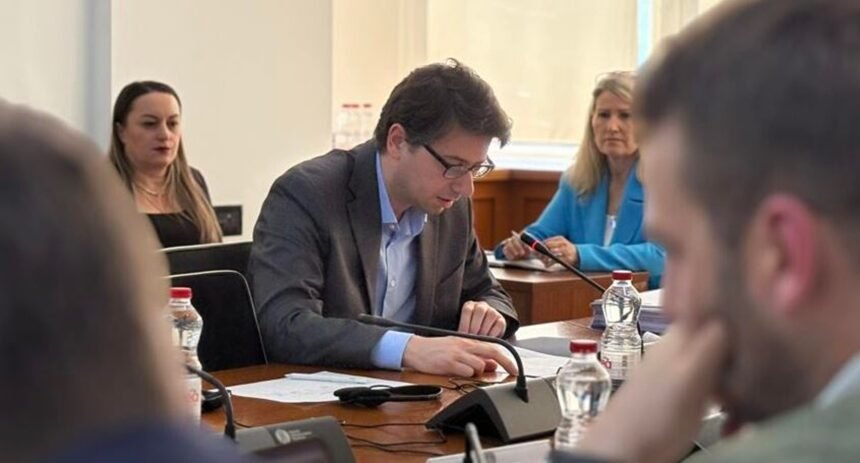
The Budget Committee has approved the draft law on payment services.
Finance Minister Hekuran Murati reported to the committee that this law aims to reduce the costs of banking payment services.
“This draft law seeks to enhance the security of payment services, promote competition and innovation, improve consumer protection, and reduce costs for domestic and cross-border payment services.
The law aligns the regulatory framework with European Union directives and regulations in the field of payments. As a result, it allows payment service providers (banks and non-banks) to participate in the Single Euro Payments Area (SEPA). In this sense, the law lays the foundation for meeting the criteria for Kosovo’s application and admission to SEPA.
It provides an appropriate framework with technical specifications for payment services and related activities within Kosovo, harmonizing with relevant EU directives and the Stabilization and Association Agreement (SAA). The goal is the full transposition of applicable directives,” Murati stated.
During the session, Enver Haliti, Budget Committee Chair from the VV party, asked about the law’s impact:
“Minister, you mentioned that the costs of international transfers for businesses would decrease. Could you explain again what the impact will be after implementation and standardization under SEPA?”
Minister Murati responded that integration into SEPA would reduce transfer costs from several hundred euros (for large amounts) to just a few euros.
“Currently, according to a study by the German Economic Team, Kosovar businesses and households (including the diaspora) are paying around €58 million more than they would if we were integrated into SEPA. This cost is roughly split equally: businesses pay about €28–29 million extra, and households pay the remaining amount.
With SEPA integration, international transfer costs would drop significantly for countries such as Switzerland, Germany, and similar SEPA members, as well as for regional countries,” Murati explained.