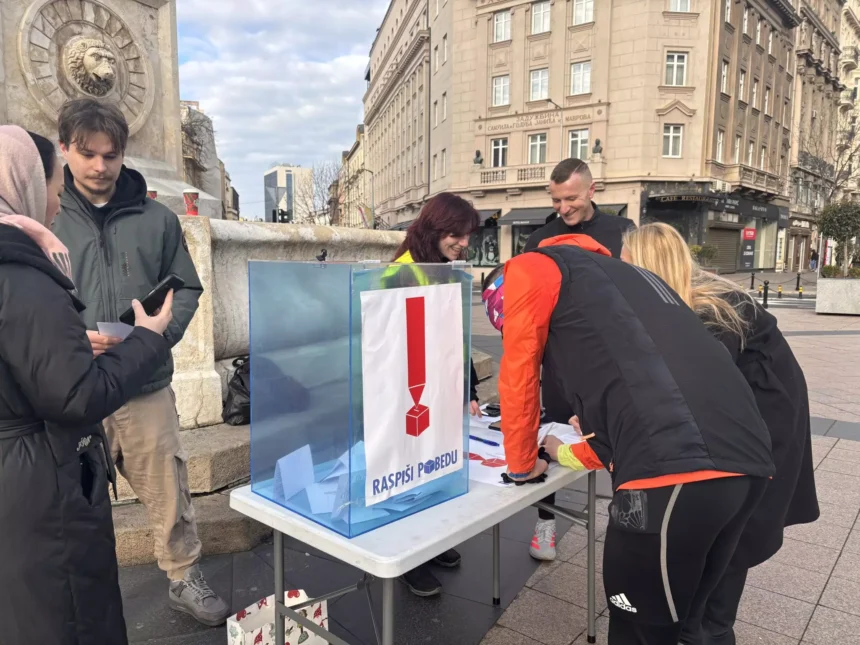
Recent local elections in ten Serbian municipalities have highlighted the growing influence of student-led civic movements, signaling a potential shift in the country’s political landscape. The elections, which saw active engagement from students and opposition groups, underscored both the challenges of voter control and the resilience of grassroots organization.
Observers reported that polling day was marked by strict oversight and pressures on voters, including the photographing of ballots and organized transportation. Despite these constraints, opposition and civic groups mobilized effectively, monitoring polling stations and working to prevent irregularities.
“The strength of democracy depends on how willing citizens are to organize and participate actively,” said Savo Manojlović from the Kreni-Promeni movement. “Direct engagement with voters on the ground makes a tangible difference.”
Political analyst Milorad Đurić described the elections as “indicative in multiple dimensions,” noting a clear trend: while the ruling Serbian Progressive Party (SNS) remains strong in formal results, the trajectory of the student-civic movement is steadily rising. “In urban centers, the student-civic movement has a distinct advantage. Nationally, the balance of power is even, but the long-term trend favors the students and civic activists,” he said.
Key factors contributing to the movement’s success included thorough staffing of election committees, which significantly limited the possibility of manipulation at polling stations. Experts emphasize that comprehensive oversight at all polling stations is crucial for future electoral victories.
Đurić also noted a clear polarization in Serbia’s political environment. “The political landscape is increasingly binary: on one side, the regime coalition; on the other, the student-civic movement. This dynamic suggests that civic engagement and student activism are becoming central to Serbia’s democratic process,” he said.
The elections have demonstrated that organized, grassroots mobilization by students and civil society can effectively challenge entrenched political powers, offering a model for future civic engagement in Serbia.