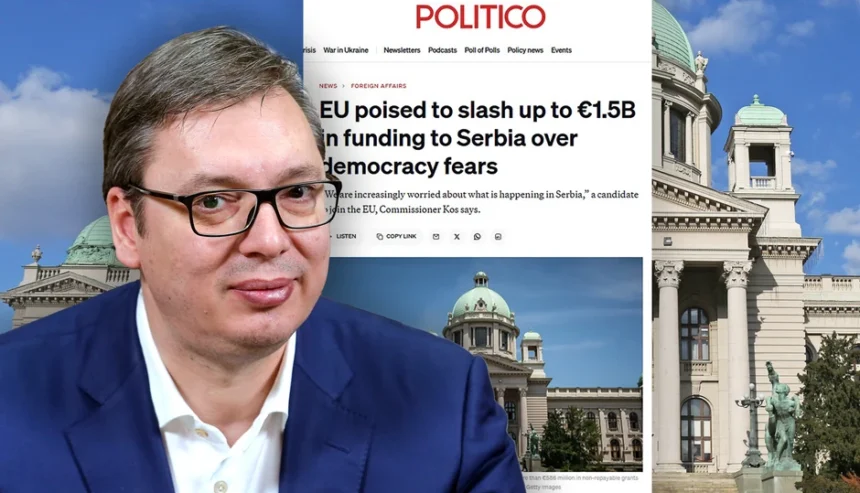
Brussels is increasing pressure on Serbia, with reports suggesting that the country could lose up to €1.5 billion in European Union funding if concerns over democratic backsliding and foreign policy alignment are not addressed.
According to reporting by Politico, the European Commission is actively reviewing whether Serbia continues to meet the conditions required to receive financial assistance under EU enlargement and reform support instruments.
The developments come as tensions grow between Belgrade and Brussels over Serbia’s refusal to align with EU foreign policy positions, particularly regarding sanctions against Russia.
European Commissioner for Enlargement Marta Kos warned that the EU is “increasingly concerned” about developments in Serbia, citing issues such as weakening judicial independence, pressure on protesters, and interference in independent media.
She also stressed that candidate countries are expected to align more closely with EU foreign policy, without directly naming Russia.
Financial pressure linked to reforms and political alignment
Serbia, while not an EU member state, has been in accession negotiations since 2014 and benefits from substantial EU financial assistance intended to support reforms and alignment with EU standards.
However, internal discussions within the European Commission reportedly include the possibility of suspending or reducing funding due to concerns over democratic standards and Serbia’s foreign policy orientation.
EU officials quoted anonymously by Politico claim that pressure is growing within the Commission to take stronger action, including limiting financial disbursements.
Serbia’s response: commitment to EU membership
Serbia’s ambassador to the EU and chief negotiator Danijel Apostolović rejected the idea that funding would be suspended, expressing confidence that cooperation with Brussels will continue.
He reiterated that Serbia remains committed to full EU membership and continues to engage in negotiations with EU institutions.
EU criticism of judicial reforms
The EU has also criticized recent legal reforms in Serbia, particularly changes affecting judicial appointments and the structure of courts and prosecution offices.
Commission officials described these reforms as a “serious step backward” for rule of law standards, reinforcing broader concerns about institutional independence.
Political context and Russia factor
The funding debate is closely linked to Serbia’s foreign policy position, especially its refusal to impose sanctions on Russia despite repeated EU calls for alignment.
Serbian President Aleksandar Vučić has previously defended this stance, arguing that Serbia maintains strategic autonomy while continuing its EU accession path.
Broader implications for EU enlargement
The potential suspension of funds would mark a significant escalation in EU enlargement policy toward Serbia and could complicate the broader Western Balkans accession process.
At the same time, EU officials emphasize that financial support is conditional on reforms, democratic standards, and alignment with the bloc’s foreign policy framework.
As discussions continue in Brussels, Serbia finds itself under growing pressure to choose between deeper alignment with the EU or maintaining its current balanced foreign policy approach toward Moscow.