European Council President António Costa has called for a “deeper and stronger” strategic partnership between the European Union and Gulf states, as Brussels moves to reinforce diplomatic and security cooperation in response to escalating tensions linked to the war involving Iran.
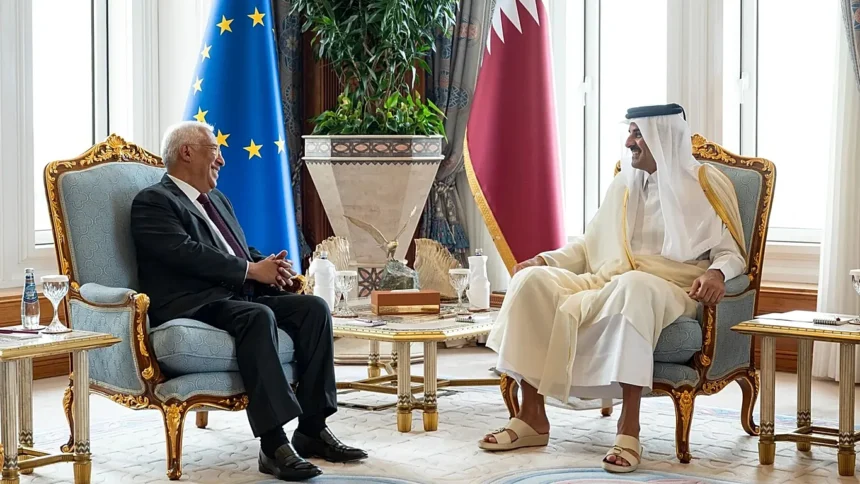
Speaking in Doha at the end of a regional tour that included Saudi Arabia, the United Arab Emirates, and Qatar, Costa said the EU’s engagement with Gulf countries is entering a new phase shaped by growing geopolitical instability and shared security concerns.
The visit marks the highest-level EU diplomatic mission to the Gulf since the outbreak of the conflict, and comes as European leaders seek to stabilize regional tensions and safeguard global energy and trade routes.
Costa emphasized that the EU is working closely with Gulf Cooperation Council (GCC) states on a range of issues, including trade agreements, security coordination, and long-term strategic cooperation. He said both sides share an interest in expanding cooperation, particularly in light of current global uncertainty.
According to Costa, the European Union will aim to hold a second EU-GCC summit before the end of the year to translate political dialogue into “concrete deliverables” across key sectors such as energy, trade, and investment.
A central focus of his discussions was maritime security, particularly the Strait of Hormuz and the Red Sea, which Costa described as “vital arteries” for global energy flows and international trade. He warned that continued instability in the region could have “disastrous consequences” for the global economy.
He also stressed the importance of maintaining a stable ceasefire in the wider Middle East and supporting diplomatic efforts to prevent further escalation. Costa said international partners should build on recent mediation efforts to ensure a lasting reduction in hostilities.
The EU Council President praised Qatar’s role as a mediator in regional conflicts, including its diplomatic efforts during the Gaza crisis, and highlighted Doha’s contribution as a “strategic partner” for European engagement in the region.
Costa also addressed broader regional security issues, including concerns over Iran’s nuclear and ballistic missile programs, as well as the activities of armed groups contributing to instability across the Middle East.
He reaffirmed the EU’s commitment to supporting safe maritime navigation and regional stability, stating that the European Union aims to remain a “reliable and predictable partner” for Gulf states amid ongoing geopolitical uncertainty.
Costa concluded that the current international environment underscores the need to uphold a rules-based global order, warning that failure to do so would increase global instability.