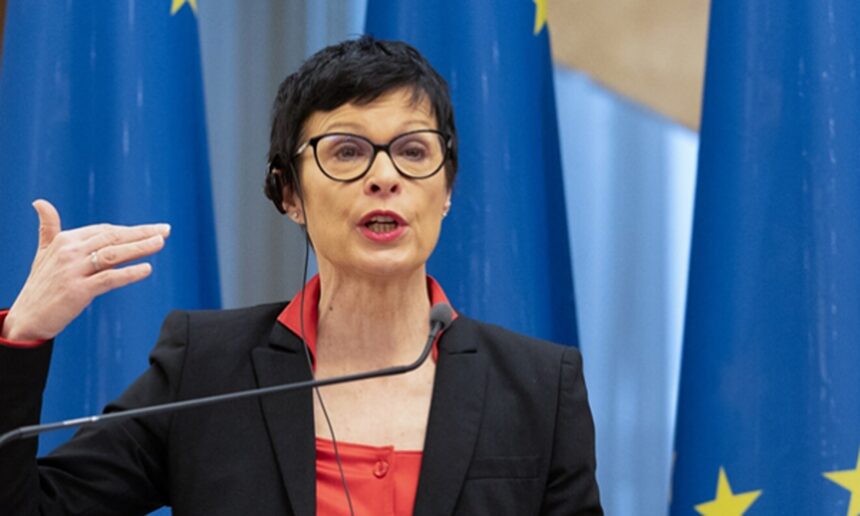
Marta Kos said on Tuesday that Europe’s security is closely tied to stability in the Western Balkans and stressed that the European Union must find practical ways to accelerate the region’s integration into European structures.
She made the remarks following the first ministerial meeting of the “Friends of the Western Balkans” group, held in Bratislava.
“Europe’s security is very much linked to stability in the Western Balkans. Therefore, we must find practical ways to bring the region closer to the European Union. History shows that only two Western Balkan countries — Croatia and Slovenia — are EU members. We need to do more, and that was at the center of today’s discussions,” Kos stated.
She warned that the EU cannot allow security gaps to widen in its neighborhood, especially amid what she described as a “crazy geopolitical situation,” adding that external destabilizing forces are attempting to undermine both the EU and countries aspiring to membership.
“For the first time, there are outside forces that want to see both the European Union and candidate countries fail in the enlargement process. These actors can interfere and use these countries against us,” she said.
Kos highlighted Albania as a positive example, noting that all negotiation chapters have already been opened and expressing hope for rapid progress toward closing them. She also said North Macedonia has recently accelerated its reform agenda.
“Our ambition is for the entire region to move forward, because ultimately all Western Balkan partners belong in the European Union as equal members, with full rights and responsibilities, based on full alignment with EU laws and values,” Kos emphasized.
Meanwhile, Juraj Blanár said Western Balkan countries have the opportunity to benefit from EU financial and integration support in order to address challenges such as youth migration and economic development needs.
He pointed to Albania and Montenegro as positive examples for the rest of the region on the path toward EU membership.
“We believe countries such as Slovakia, Montenegro, and Albania can serve as positive examples for all peoples of the Western Balkans that this path is achievable,” Blanár said.
The Friends of the Western Balkans group includes Austria, Croatia, Greece, Czech Republic, Slovakia, Italy, and Slovenia.
Representatives from Albania, Bosnia and Herzegovina, Montenegro, North Macedonia, Serbia, and Kosovo also attended the meeting in Bratislava.
Kosovo officially applied for EU candidate status in December 2022, but no formal decision has yet been made by Brussels.