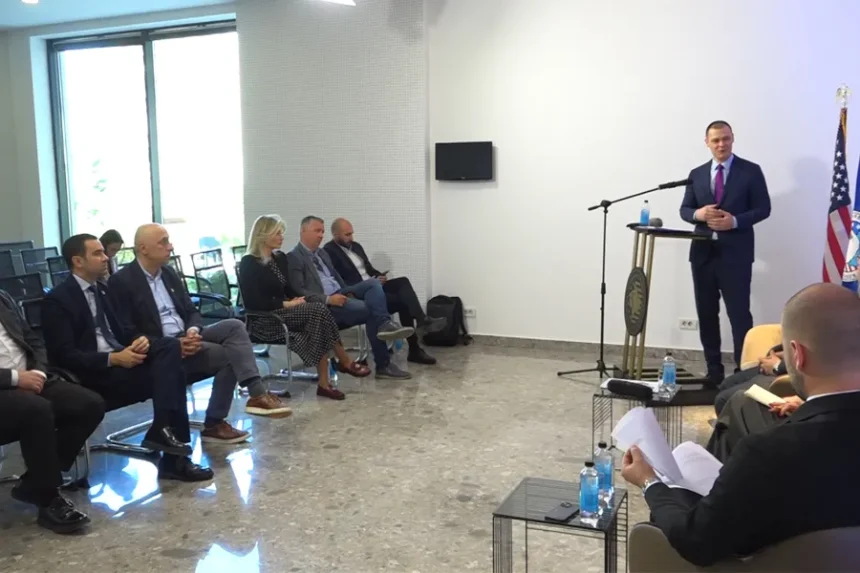
The official functionalization of the Administrative Court last week is being hailed by legal experts and business leaders as a pivotal moment for Kosovo’s justice reform.
During a discussion organized by the American Chamber of Commerce (AmCham) on May 14, 2026, stakeholders emphasized that this specialized court will significantly enhance legal certainty and the protection of citizens and businesses in their disputes with public administration.
Strengthening Legal Certainty
Rexhep Gashi, the Acting President of the Administrative Court, stated that the court’s primary role is to serve as a check on public administration.
“The functionalization of this court represents a major step toward the rule of law and the advancement of judicial protection. The court will provide a specialized venue for all parties seeking protection against administrative actions,” Gashi explained.
Business Community Expectations
Arian Zeka, Chairman of the American Chamber of Commerce in Kosovo, described the establishment of the court as one of the most significant developments in the country’s judicial architecture this year.
Lawyers representing the private sector highlighted what businesses hope to gain from this new institution:
- Reduced Bureaucracy: Businesses are looking for streamlined processes and a clear address for resolving disputes.
- Predictability: Legal experts like Vjosa Shkodra noted that companies require predictable legal outcomes to plan investments.
- Specialization: Agon Drini from Kerveshi & Partners noted that alongside the Commercial Court, the Administrative Court forms the “cornerstone” of this year’s justice reforms.
The Challenge: Case Backlogs and “Staleness”
Despite the optimism, there is significant concern regarding the transition of old cases.
- The Fear of Delays: Legal experts expressed worries that the Administrative Court might be “haunted” by the massive backlog of existing administrative cases.
- The Solution: To mitigate this, officials announced that experienced judges will be transferred to the new court to ensure expertise and efficiency from day one.
Historical Context: A Decade of Reform
The road to a dedicated Administrative Court has been long. The handling of administrative conflicts in Kosovo has shifted several times over the years:
| Period | Competent Authority |
| Pre-2013 | The Supreme Court of Kosovo |
| 2013 – 2026 | Basic Court in Pristina (Department for Administrative Affairs) |
| May 2026 – Present | The Administrative Court of Kosovo (Specialized) |
By centralizing these cases into a single, specialized court, the government aims to professionalize the oversight of state decisions and provide faster resolutions for the public.