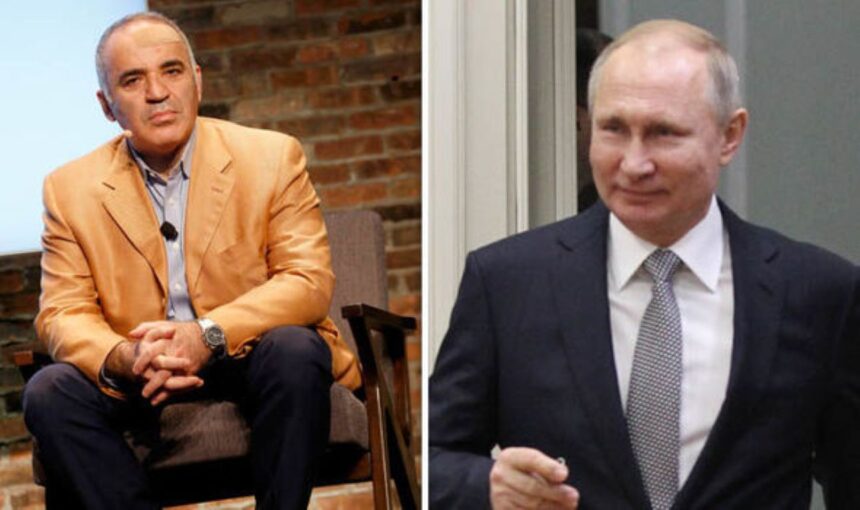
Legendary Russian chess grandmaster, political activist, and author Garry Kasparov has issued a stark warning to Western democracies regarding the long-term geopolitical strategy of Russian President Vladimir Putin.
Analyzing the historical revisionism routinely deployed by the Kremlin, Kasparov emphasized that authoritarian leaders leave a highly predictable trail of intent, which the democratic world dangerously misreads as mere political posturing.
[THE KASPAROV GEOPOLITICAL FRAMEWORK] • The Maxim: “Dictators always lie about the past—but they tell you exactly what they will do.” • The Genesis: Putin’s 2005 speech labeling the USSR’s collapse a “geopolitical catastrophe.” • The Turning Point: The 2007 Munich Security Conference speech attacking NATO. • The Final Goal: Dismantling the post-Cold War security architecture; pushing NATO to 1997 borders.
Deciphering the Imperial Roadmap
Kasparov argues that Putin’s public manipulation of history has never been an intellectual exercise, but rather a literal indicator of his long-term expansionist objectives.
The grandmaster tracks the current collapse of European stability back to two foundational baseline events:
- The 2005 Contextual Shift: In his annual address to the nation, Putin explicitly defined the dissolution of the Soviet Union as “the greatest geopolitical catastrophe of the 20th century.” Kasparov identifies this moment as the formal birth of modern Russia’s neo-imperial doctrine.
- The 2007 Munich Pivot: During his address at the Munich Security Conference, Putin unleashed a fierce, unprecedented broadside against the unipolar world order, Western democratic structures, and NATO enlargement. Kasparov notes this was the exact juncture where Moscow committed to actively subverting Euro-Atlantic security systems.
Ukraine is a Component, Not the Destination
According to Kasparov’s chess-like strategic analysis, Western leaders remain caught in a dangerous cycle of short-term reactive policy because they treat individual invasions as isolated events.
[THE STRATEGIC AXIS OF KREMLIN EXPANSION]
│
┌─────────────────────────────┼─────────────────────────────┐
▼ ▼ ▼
[HISTORICAL REVISION] [UKRAINE INVASION] [GLOBAL RE-ALIGNMENT]
Weaponizing USSR nostalgia Operating as a tactical Forcing NATO to retreat to its
to manufacture domestic stepping stone, not the pre-1997 borders and creating
consent for expansion. ultimate territorial limit. fragmented European buffer zones.
He maintains that while Ukraine is the most immediate target of Russia’s revisionist machine, it is merely a stepping stone. Putin’s ultimate grand strategy is the total structural dismantlement of contemporary European security—specifically aiming to pressure NATO into rolling back its collective defense lines to their pre-1997 parameters.
Western Blindness to Chronic Threats
The core danger, Kasparov warns, lies in Europe’s persistent diplomatic complacency. Despite years of active subversion, asymmetric warfare, and overt territorial aggression, many continental capitals still treat the Kremlin’s declarations as hollow rhetoric designed for domestic consumption.
| Democratic Misconception | Strategic Reality (Kasparov’s View) | Consequence of Inaction |
| “Local Conflict” | Ukraine is treated as a isolated border dispute. | Allows Russia to consolidate resource bases for subsequent regional operations. |
| “Rhetorical Posturing” | Speeches on imperial revival are dismissed as political theater. | Blinds democratic planning to the literal roadmap of impending invasions. |
| “Potential Threat” | Aggression is classified as a future, conditional risk. | Prevents the immediate, total mobilization required to deter an active, kinetic threat. |
Kasparov concluded his critique with a sharp call to action, insisting that the international community must transition from treating Russia as a theoretical or manageable risk. Instead, he urged the West to recognize the Kremlin as an active, existential threat to global democratic stability—one that cannot be appeased through concessionary diplomacy.