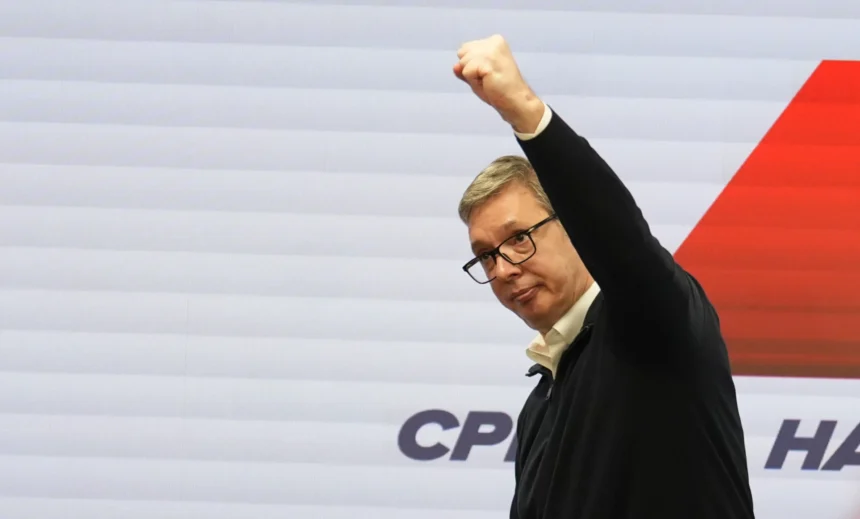
A shocking political declaration has thrown Serbia’s political landscape into deep uncertainty. Speaking before thousands of bused-in supporters at a major Serbian Progressive Party (SNS) rally in central Belgrade, President Aleksandar Vučić announced that he would remain head of state “for only a few more weeks.”
If carried out, Vučić would resign nearly a year before his official presidential mandate expires in May 2027. Having already served the constitutional maximum of two consecutive presidential terms, the populist leader cannot run for the presidency again.
Political analysts and monitoring groups look at this sudden “strategic retreat” not as a retirement, but as a Calculated Gambit to bypass constitutional limits and tighten his grip on state power by transitioning back into the role of Prime Minister.
The Constitutional Loophole: Retaining Power Without Elections
The central reality of Serbia’s political apparatus is that Vučić does not need to call new parliamentary elections to become Prime Minister. The ruling SNS party holds an absolute majority in the parliament, controlling 136 out of 250 seats.
According to the Constitution of Serbia, if the current, highly marginalized Prime Minister, Đuro Macut, resigns or steps aside, the existing parliamentary majority can simply vote Vučić directly into the premiership.
                       [The Serbian Executive Pivot]
                                     │
      ┌──────────────────────────────┴──────────────────────────────┐
      ▼                                                             ▼
 [The Presidency]                                             [The Premiership]
 Currently held by Vučić. Constitutionally                      Holds the actual executive power
 protocol-heavy; limited to 2 terms.                           under the law; no term limits.
      │                                                             ▲
      └─────────────────── [Strategic Shift] ───────────────────────┘
                     Vučić resigns early to assume the
                     constitutionally supreme executive chair.
Dušan Spasojević, a prominent professor at the Faculty of Political Sciences in Belgrade, notes that moving to the prime minister’s office would align Vučić’s official title with his actual, extra-constitutional role as Serbia’s sole decision-maker:
Prof. Dušan Spasojević: “His eventual arrival at the position of prime minister would simply place him, in a constitutional sense, where he already sits as the main political figure who makes all decisions in the country. This is the launch of a ‘Putin-Medvedev’ model, or the maneuvers executed multiple times by former Montenegrin strongman Milo Đukanović. This tradition asserts that power follows the leader, not the office.”
Calculated Tactics Against Growing Domestic Protests
The timing of Vučić’s announcement is directly tied to mounting domestic crises. Since November 2024, the regime has been shaken by continuous, massive anti-government street protests led by student organizations like “Students in Opposition” (Studenti u blokadi). The movement accuses the administration of deep-seated corruption and has consistently demanded early parliamentary elections.
By threatening an abrupt resignation, Vučić is effectively seizing control of the political clock:
- Campaign Control: Forcing simultaneous presidential and parliamentary elections allows Vučić to place his own name at the center of a nationwide campaign, shielding the vulnerable SNS party from localized losses.
- Preventing a Successor Crisis: The move signals that the SNS inner circle fears an alternative presidential candidate would struggle to win the 2027 election cleanly amid the ongoing protest wave. By jumping to the premier post early, Vučić can install a loyalist figurehead into the presidency while keeping the true executive leverage for himself.
What Happens the Day Vučić Resigns?
The legal process following a presidential resignation follows a strict constitutional timeline, elevating one of the regime’s most trusted operators to temporary head of state:
| Phase of Transition | Legal Mechanism | Operational Reality |
| Immediate Succession | Parliamentary Speaker Ana Brnabić becomes Acting President. | Brnabić, a three-time former prime minister, assumes the post for a maximum of 90 days. |
| Election Window | Presidential elections must be declared immediately. | If Vučić steps down by late July, snap presidential elections would hit by October. |
| Executive Realignment | SNS majority selects the new Prime Minister. | Parliament votes Aleksandar Vučić into the Prime Minister’s chair with absolute executive authority. |
The Serbian Presidency and the SNS party have tightly locked down their communications, refusing to respond to formal media requests regarding the exact date of the planned resignation.
However, coming directly on the heels of independent reports from the monitoring group BIRODI—which documented that Vučić completely dominates national news broadcasts over the actual government cabinet—the upcoming maneuver proves that Serbia is preparing for an institutional shift designed to solidify personal rule well past 2030.