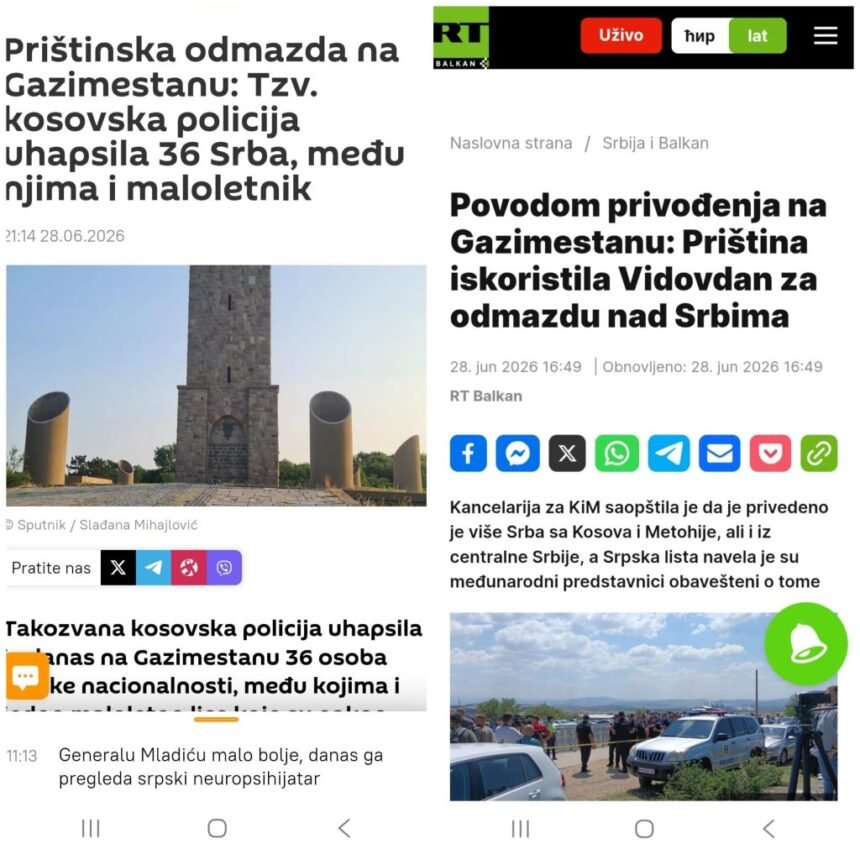
Following the recent Vidovdan gatherings at Gazimestan, a stark divide has emerged between documented law enforcement actions and the narratives spun by foreign state media. While Kosovar authorities confirmed that detentions at the historic site were strictly due to public order disruptions and the display of provocative nationalist messages, Russian state-backed outlets Sputnik Serbia and RT Balkan launched a coordinated propaganda campaign to reframe the event entirely.
Through nearly identical articles, these outlets actively promoted severe narratives of “torture,” “revenge,” and “terror against Serbs,” systematically attempting to portray Kosovo as a purely repressive regime while casting Serbia as the permanent victim.
Anatomy of Synced Propaganda: Identical Texts and Emotionally Charged Rhetoric
An analysis of the coverage reveals an almost absolute alignment in content, terminology, and biased sourcing between Sputnik and RT Balkan.
- Prejudiced Headlines: Instead of informative reporting, headlines like “Kurti’s Torture for Vidovdan” and “Prishtina’s Revenge in Gazimestan” deliver predetermined political judgments designed to trigger immediate emotional reactions.
- Delegitimizing State Institutions: Both outlets consistently utilize the phrase “the so-called Kosovo Police,” a standard pro-Kremlin linguistic model explicitly designed to deny the legitimacy of Kosovo’s state institutions.
- Inflammatory Vocabulary: The articles rely heavily on unsupported, highly aggressive terminology rather than verifiable facts, using phrases such as “Kurti’s phalanxes,” “regime repression,” and an “anti-civilizational act of violence.”
             [The Anatomy of a Coordinated Disinformation Loop]
                                      │
                                      ▼
               [ Law Enforcement Action at Gazimestan ]
              (Detentions for public order/nationalist symbols)
                                      │
                                      ▼
             ┌────────────────────────┴────────────────────────┐
             ▼                                                 ▼
     [Sputnik Serbia]                                    [RT Balkan]
  "Kurti's Torture for Vidovdan"                     "Prishtina's Revenge"
             │                                                 │
             └────────────────────────┬────────────────────────┘
                                      ▼
                 [ Core Disinformation Output: ]
            - Denial of institutional legitimacy ("so-called")
            - Framing legal infractions as ethnic persecution
            - Weaponizing religious/historical sentiment
The Mechanics of Manipulation: Selective Sourcing and Echo Chambers
A fundamental characteristic of this propaganda campaign is its extreme asymmetry in sourcing. The reports completely exclude any statements or context from the Kosovo Police, state prosecutors, or relevant legal institutions.
Instead, readers are presented with an exclusive echo chamber, citing only the Serbian Government’s Office for Kosovo, Petar Petković, Serb List (Srpska Lista), Miloš Vučević, and defense attorneys. By intentionally omitting the legal basis for the police intervention, the media outlets transform standard law enforcement into an automated narrative of systematic ethnic persecution.
Multi-Article Echoing: The Repetition Technique
To maximize impact, RT Balkan deployed the classic propaganda technique of coordinated message reinforcement, publishing multiple articles throughout the same day to build an artificial atmosphere of widespread fear and crisis:
| Headline Title | Core Propaganda Vector | Tactical Focus |
| “Regarding the detentions in Gazimestan: Prishtina used Vidovdan for revenge against Serbs” | Uncritical Transmission | Directly copy-pastes official Belgrade press releases without any editorial distance or fact-checking. |
| “Tensions in Gazimestan: Prishtina police detained several dozen Serbs” | Emotional Escalation | Focuses heavily on sentimental details (“a father with his child,” “young girls”) and the deployment of special units to imply peaceful churchgoers were targeted solely for singing patriotic songs. |
By explicitly referencing detentions from previous years and labeling them as “similar attacks,” the network manufactures an illusion of an ongoing, calculated state policy against Serbs during every Vidovdan holiday.
The Strategic Goal: Local Mobilization and International Delegitimization
This coordinated media strategy serves a dual geopolitical purpose for both Belgrade and Moscow. Locally, it exploits the deep cultural and religious symbols of Vidovdan—such as references to the “Kosovo Covenant” and the “Heavenly Kingdom”—to mobilize nationalist sentiments and maintain regional friction.
Internationally, the campaign is calculated to delegitimize Kosovo before its Western partners. By painting a false picture of systemic human rights abuses, Russia seeks to undermine Kosovo’s international standing while reinforcing its long-standing Balkan narrative: portraying Serbs as perpetual victims of Western-backed institutions.