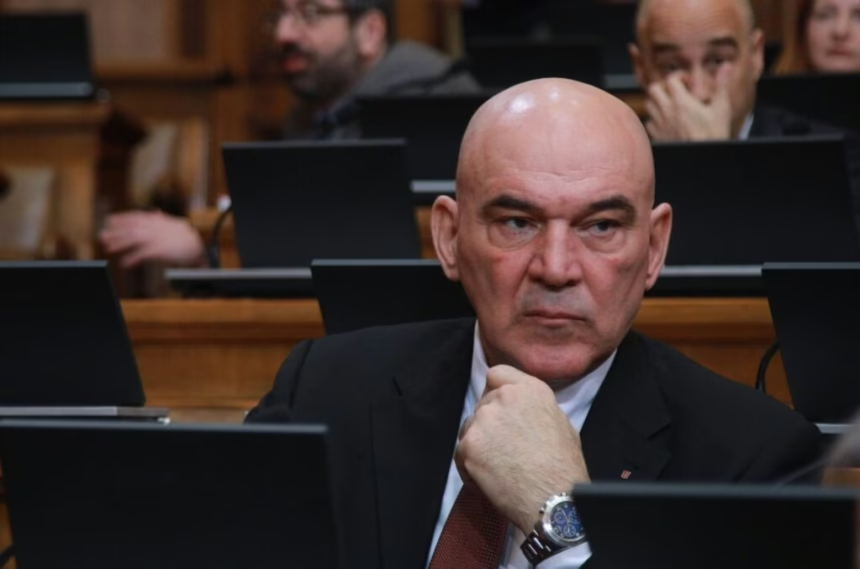
Highlighting deep institutional fractures within Serbia’s judicial and security frameworks, Petar Bošković, an MP and Presidency Member of the opposition Srbija Centar (SRCE) party, has accused President Aleksandar Vučić’s administration of deploying state organs and media tools to systematically evade public accountability.
Speaking in an expansive interview with Nova.rs on Monday, July 6, 2026, Bošković dissected the controversial “sound cannon” investigation, the upcoming snap election cycle, and the widening infrastructure management deficit in Belgrade.
The “Sound Cannon” Case: Judicial Weaponization and Military Overreach
The ongoing legal dispute stems from a mass demonstration on March 15, where opposition leaders alleged that state security forces deployed acoustic crowd-control weapons against protestors. The Higher Public Prosecutor’s Office subsequently opened a case—not against state officials—but against student activists, accusing them of “simulating” the weapon’s frequency to incite public panic.
                    [THE DEVIATION OF INVESTIGATIVE MANDATE]
                                       │
         ┌─────────────────────────────┴─────────────────────────────┐
         ▼                                                           ▼
  [THE LEGAL RED LINE]                                        [THE STRUCTURAL OUTCOME]
  ────────────────────                                        ────────────────────────
  • VBA (Military Security Agency) holds zero                 • Case files leaked to pro-regime tabloids
    jurisdiction over civilian protest spaces.                  within 10 minutes of testimony closure.
  • Military Police legally barred from executing              • Public figures targeted by name; active
    investigative actions outside active military.             criminals shielded under structural initials.
Bošković, a veteran defense analyst and the former Head of the Public Relations Department at the Ministry of Defense, strictly condemned the mobilization of the Military Security Agency (VBA) and the Military Police in the ongoing civilian probe, identifying Vučić’s personal adjutant, General Đuro Jovanić, as the catalyst behind the overreach.
“There is absolutely no legal basis under any current law for the VBA or the Military Police to operate within this case,” Bošković stated. “It involves neither the military internally nor externally. This is a blatant, arrogant evasion of accountability utilizing the judiciary to bury real systemic issues—from infrastructure scandals to multi-million Expo investments.”
The Tabloid-Police Axis
The procedural concerns were amplified following the recent interrogation of SRCE President Zdravko Ponoš by the Criminal Police Directorate (UKP). Bošković revealed that pro-government media networks, specifically the tabloid Informer, obtained and printed Ponoš’s testimonies before the prosecutor’s office could formally archive the records.
“We have reached a dangerous deviation where state intelligence structures track, record, and leak the deep intimacies of public figures and opposition MPs,” Bošković warned. “It is an orchestrated campaign designed to intimidate the populace and suppress political dissent.”
“Shell-Game Diplomacy” with Election Timelines
Addressing persistent speculation regarding another wave of extraordinary legislative polls, Bošković expressed skepticism that the ruling Serbian Progressive Party (SNS) will implement genuine electoral reforms.
                    [BELGRADE'S EXECUTIVE POWER CONCENTRATION]
                                       │
         ┌─────────────────────────────┼─────────────────────────────┐
         ▼                             ▼                             ▼
  [THE TIMELINE MANIPULATION]    [THE MITING RECOIL]           [THE ABSOLUTE MONOPOLY]
  ───────────────────────────    ───────────────────           ───────────────────────
  • Dates consistently shifted   • Failure of multi-day        • No internal power
    from "weeks" to "autumn"       state rally signals           redistribution exists;
    to disrupt opposition.         eroding core mobilization.    all levers trace back.
He dismissed suggestions that Vučić’s teased resignation from the presidency to seek the Prime Minister’s seat represents an internal redistribution of power, characterizing the maneuver as a classic shell game (šibicarenje) with calendar dates.
| Structural Arena | Regime Posture | Observed Reality |
| Electoral Integrity | Proclaiming adherence to international standards. | Maintaining restrictive conditions built on media monopolies and institutional coercion. |
| Capital Infrastructure | Launching high-profile tourist monuments on Terazije. | Pushing a hyper-urbanized “concrete block” model while key Danube suburbs lack foundational sewage networks. |
| Traffic Integration | Building new roundabouts at Nikola Pašić Square. | Creating design bottlenecks where drivers cannot physically enter newly built garage corridors without looping the city. |
The Urban Decay of the Capital
Shifting his focus to local governance, the SRCE official leveled scathing criticism at Belgrade Mayor Aleksandar Šapić, labeling him the least effective administrator in the city’s modern history. Bošković criticized the wholesale transformation of Belgrade into an unnavigable enclave, citing the visual degradation of Pioneer Park and the chaotic execution of transit circles.
“The current administration has detached itself completely from the real needs of Belgraders,” Bošković concluded. “When a mayor spends more time in Trieste and Barcelona than navigating the infrastructure he broke, it is a sign that municipal governance requires an immediate, professional overhaul.”