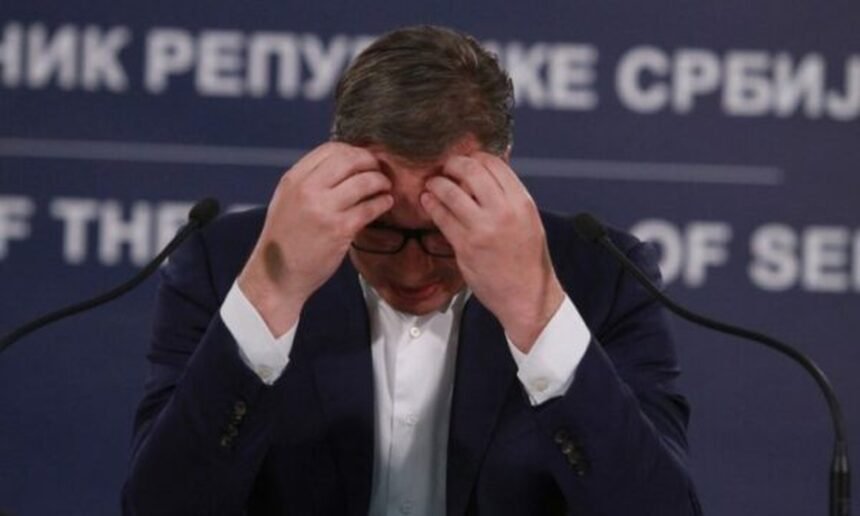
Serbian President Aleksandar Vučić has claimed that no European leader in recent years has faced the level of political pressure and criticism that he has experienced, while defending his decade-long rule and presenting his record as a success ahead of the upcoming elections.
Speaking in the first episode of the podcast “Masterclass with Rainer Novak” by the Austrian newspaper Die Presse, Vučić rejected accusations that he has become more authoritarian, arguing that years of criticism against him were based on what he described as false allegations.
“I believe that what I have gone through, no European leader has gone through, at least not recently,” Vučić said, claiming that Serbian and foreign media had conducted campaigns against him over cases including the Jovanjica affair, allegations related to the use of a sound cannon, and accusations concerning his alleged involvement in crimes during the war in Sarajevo.
Vučić said those accusations had ultimately been proven false, while critics and opposition groups have continued to challenge his claims and accuse his government of weakening democratic institutions, limiting media freedom, and using state structures to maintain political control.
The Serbian president also highlighted economic indicators as one of the main achievements of his government, saying that Serbia has significantly improved its position compared with neighboring countries over the past decade.
“When you visited Serbia in 2017, Montenegro was 50 percent ahead of us, and Bosnia and Herzegovina was 22 percent ahead of us. Today, we are ahead of everyone,” Vučić said, referring to average salaries and pensions.
Discussing Serbia’s European integration process, Vučić said he remained committed to EU membership despite what he described as disappointments with Brussels, particularly regarding the lack of progress in opening new negotiation chapters.
He said that during a recent EU-Western Balkans summit in Tivat, he met with European leaders including German Chancellor Friedrich Merz, French President Emmanuel Macron, European Commission President Ursula von der Leyen, and European Council President António Costa.
According to Vučić, European officials questioned whether Serbia was still genuinely committed to the EU path.
“I told them that I am disappointed with many things, especially after 2013 when we signed the Brussels Agreement. We fulfilled all our obligations,” he said.
Regarding his participation at the Southeast Europe and Ukraine summit in Kyiv, Vučić said Serbia had demonstrated respect for the UN Charter and territorial integrity principles, including support for Ukraine’s territorial integrity.
He said Serbia had provided humanitarian assistance to Ukraine in financial, healthcare, and energy sectors, and that Belgrade had agreed to participate in rebuilding a small Ukrainian city.
Addressing criticism from Russia over his cooperation with Kyiv, Vučić said Serbia had not done anything inconsistent with its previous policy.
“When I am criticized here, there are many people who care more about the interests of other countries than their own country’s interests,” Vučić said, adding that he had asked Russian officials what Ukraine had done against Serbia.
Ahead of the elections, Vučić said his campaign message would focus on the need for harder work and continued development, describing this as an unusual approach before elections.
He also pointed to International Monetary Fund forecasts predicting strong economic growth for Serbia and praised the stability of the Serbian dinar.
“These are great news that nobody wants to talk about. Everyone wants a weaker Serbia, weaker leaders, a less independent Serbia,” Vučić said.
However, opposition parties and civil society organizations have repeatedly criticized Vučić’s government, accusing it of concentrating power around the Serbian Progressive Party (SNS), restricting political competition, and using state resources to influence electoral conditions.