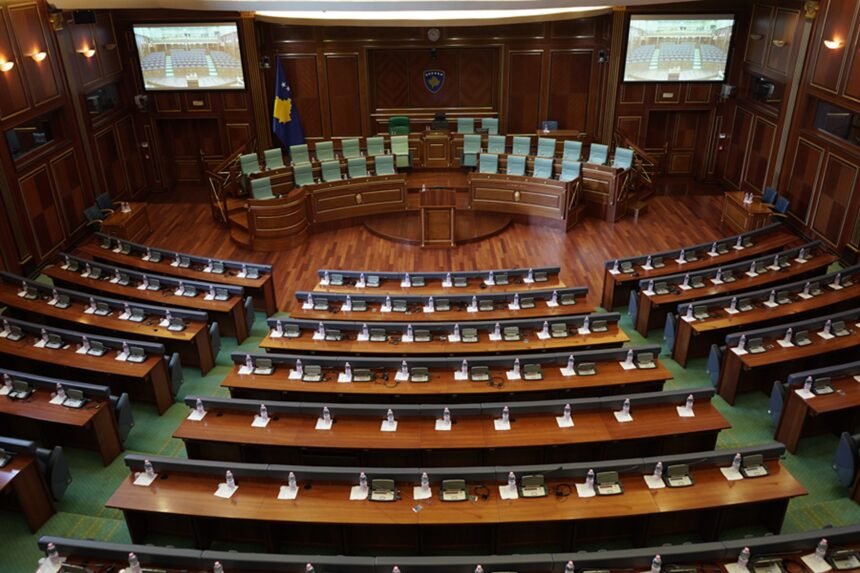
Kosovo’s Acting President and Speaker of Parliament, Albulena Haxhiu, has scheduled the constitutive session of the newly elected Assembly for August 6, giving political parties additional time to reach an agreement on the election of the country’s next president.
Haxhiu said she intentionally avoided calling the session earlier in order to allow parliamentary parties more time to negotiate and find a consensus on the presidential position, which requires a broad political agreement.
“The responsibility for electing the president or president should go beyond a single political party,” said Acting Prime Minister Albin Kurti, adding that all parties must contribute to the formation of functioning state institutions.
The constitutive session must be completed within 30 days from the official certification of election results, according to the interpretation of the Constitutional Court. If the Assembly is not constituted within this period, the court’s decision does not specify direct legal consequences, but delays could affect the subsequent deadline for electing the president.
Under Kosovo’s constitutional framework, the president must be elected within 60 days after the Assembly is constituted. If the election process fails, the Assembly is dissolved and early elections are called.
Kurti’s Vetëvendosje Movement (LVV), which won the June 7 elections with 53 seats, has enough support with minority representatives to elect the speaker of parliament and form a government. However, electing the president requires a two-thirds quorum in the first two rounds, meaning at least 80 lawmakers must participate.
The Democratic Party of Kosovo (PDK), which secured 18 seats, has announced that it will remain in opposition, while the Democratic League of Kosovo (LDK), also with 18 seats, is facing internal disagreements over its future political direction and potential cooperation.
LDK lawmaker Arben Gashi said the current political moment requires “state responsibility, vision and political leadership,” calling for the party to redefine its identity and approach to cooperation based on Kosovo’s interests and Euro-Atlantic orientation.
Political analyst Basri Muja expressed skepticism that the institutional deadlock would be resolved quickly, saying that party negotiations have not been intensive enough to guarantee an agreement. He suggested that a non-partisan candidate could be the most suitable option for president under the current circumstances.
Researcher Eugen Cakolli from the Kosovo Democratic Institute (KDI) warned that holding the constitutive session close to the constitutional deadline could create additional pressure regarding the presidential election timeline.
According to Cakolli, once the Assembly is constituted on August 6, the 60-day period for electing the president would begin, with October 5 becoming the final deadline. Failure to elect a president by then could trigger the dissolution of parliament and new elections.
The political negotiations come after Kosovo’s previous institutional crisis, when the Assembly took months to complete its formation process following earlier elections.