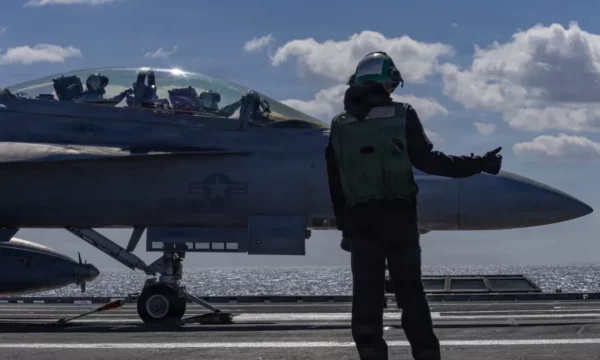
The United States and Saudi Arabia have launched coordinated airstrikes against Iran-backed militia positions in Iraq after a new wave of missile and drone attacks targeting U.S. forces and Saudi energy infrastructure, marking a renewed escalation in regional tensions.
The U.S. Central Command (CENTCOM) said all Iranian ballistic missiles fired at American forces in the Middle East were successfully intercepted, adding that U.S. troops remain “vigilant and at a high state of readiness.”
According to U.S. officials, Iran launched the missile barrage before American and Saudi forces carried out their joint operation in Iraq, emphasizing that the two incidents were not directly connected.
In a statement following the operation, CENTCOM said U.S. and Saudi fighter aircraft struck multiple logistics and weapons facilities used by Iran-backed militias across eastern Iraq.
“The strikes were a decisive response to more than 30 drone attacks directed by the Islamic Revolutionary Guard Corps (IRGC) over the past 72 hours,” the statement said.
The U.S. military warned that any further attacks on American personnel or Saudi Arabia’s energy infrastructure could trigger additional military action.
Saudi Arabia’s Ministry of Defense confirmed its participation in the operation, stating that while the Kingdom does not seek escalation, it “will respond to any aggression it faces.”
Earlier on Tuesday, Saudi officials announced that the country’s air defenses had intercepted and destroyed several drones targeting oil facilities in its eastern region for the second consecutive day.
Meanwhile, Iraqi Prime Minister Ali al-Zaidi ordered an investigation after Riyadh accused Iran-backed militias operating from Iraqi territory of launching the attacks. Baghdad reiterated its commitment to preventing Iraqi territory from being used as a launching pad for attacks against neighboring or allied countries.
Iran-backed Iraqi militias denied responsibility. The Islamic Resistance in Iraq, an umbrella group of armed factions aligned with Tehran, dismissed the Saudi allegations as “fabrications” and suggested that Yemen’s Houthi movement had carried out the attacks instead.
The Houthis claimed responsibility for targeting the Saudi oil tanker NCC Ghazal with missiles, forcing the vessel to turn back. The group also recently announced a blockade of Saudi shipping, raising concerns over security in the Bab el-Mandeb Strait, one of the world’s most critical maritime trade routes.
The latest developments come after several days of relative calm between Washington and Tehran following weeks of military confrontation around the Strait of Hormuz, through which roughly one-fifth of globally traded oil passes.
The renewed hostilities follow weeks of mounting pressure on U.S. President Donald Trump, with four American service members killed in recent fighting and the Pentagon seeking additional congressional funding to support the expanding military operation.