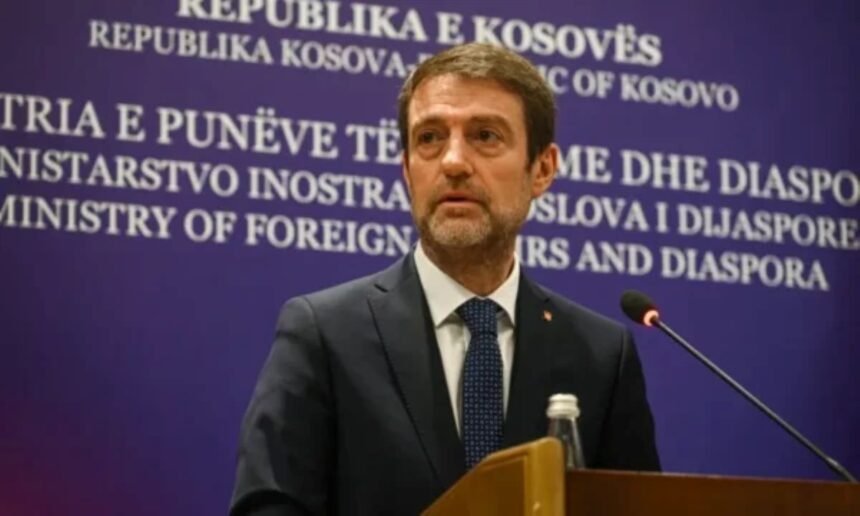
Albanian Minister for Europe and Foreign Affairs Ferit Hoxha has defended plans to establish an Albanian Consulate General in Serbia’s Preševo Valley, describing the initiative as a matter of national interest and criticizing public debate that has focused primarily on Serbia’s potential gains.
His remarks came after controversy erupted following Serbian Foreign Minister Marko Đurić’s statement regarding the possibility of Serbia opening a Consulate General in Shkodër as part of a reciprocal arrangement.
In a statement published on X, Hoxha clarified that Albania has formally requested the opening of a Consulate General in the Preševo Valley, while Serbia has requested permission to establish a Consulate General in Shkodër.
“If and when both sides reach agreement on every aspect and detail of this process, the appropriate steps will be taken at the appropriate time,” Hoxha wrote.
The Albanian foreign minister stressed that reciprocity is a fundamental principle of international diplomacy but does not imply identical objectives or equal political significance for each side.
“In established diplomatic practice, reciprocity is a fundamental principle governing relations between states and an instrument of foreign policy used to advance national interests. It does not necessarily mean equality in substance, objectives or interests,” he said.
Hoxha emphasized that Albania’s primary objective is to establish, for the first time, a permanent consular presence in the Preševo Valley, an area inhabited by a significant Albanian community.
According to him, the consulate would enable Albania to provide closer assistance to Albanian citizens living in the region, strengthen ties with the community, and better protect their legitimate rights and interests.
Responding to criticism voiced in both Albania and Kosovo, Hoxha said he found it surprising that much of the public debate had overlooked what he described as the core issue.
“It is strange, and even difficult to understand, that many reactions choose to ignore what is truly essential: Albania’s national interest and the concrete benefits of establishing a permanent Albanian consular presence in the Preševo Valley,” he stated.
He argued that instead of focusing on the support the consulate would provide to Albanians in the region, much of the discussion had shifted toward speculation about Serbia’s interests.
Hoxha concluded by reaffirming that Albania’s foreign policy is guided by national interests, international law and European values.
“Our foreign policy is not built on emotions or perceptions, but on national interest, respect for international law and established diplomatic practice, as well as European values. This is the standard we uphold today and the standard Albania intends to maintain as a future member of the European Union,” he said.
The proposed reciprocal opening of consulates in the Preševo Valley and Shkodër has generated debate across the region, with supporters highlighting the diplomatic and practical benefits for local communities, while critics question the broader political implications of the arrangement.