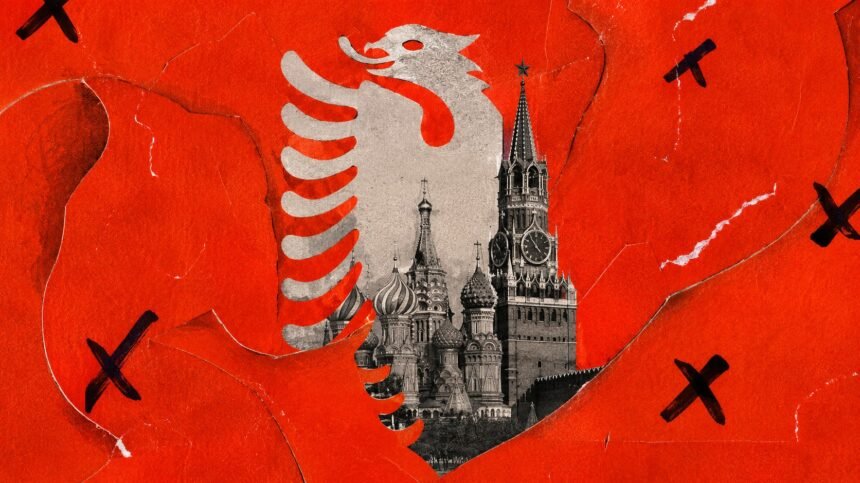
A study prepared for the European Parliament’s Committee on Foreign Affairs (AFET) has ranked Albania among the countries with limited exposure to Russian political influence, while warning that institutional weaknesses and the media environment could still create opportunities for disinformation and hybrid interference.
The report, which examines nine EU candidate and partner countries, concludes that unlike several other states in the region, Albania does not represent a favorable environment for Kremlin-backed political influence. The country remains strongly oriented toward the European Union and NATO, with no consolidated pro-Russian political base among voters.
However, the study highlights vulnerabilities that could be exploited by foreign actors, including limited media pluralism, online disinformation, corruption, politicization of public administration, and low levels of public trust in institutions.
According to the report, these weaknesses could be used to influence public opinion, reduce voter participation, undermine confidence in election results, or discredit political forces supporting democratic reforms and European integration.
The analysis also notes that Albania has not seen the creation of political parties linked to Russian interests, unlike some other countries in the Western Balkans and neighboring regions.
Instead, the study refers to documented cases from 2018 and 2019 that identified attempts to establish covert influence channels and penetrate administrative structures.
One of the report’s key findings concerns disinformation campaigns. Based on data from EUvsDisinfo, between January 2015 and February 2022, an average of one documented disinformation case targeting Albania was identified every 174 days.
Following Russia’s full-scale invasion of Ukraine, from February 24, 2022, to April 29, 2026, the study recorded no newly documented cases of Russian disinformation targeting Albania. Alongside North Macedonia, Albania was the only country included in the analysis without newly registered cases during that period.
Nevertheless, the authors stress that the absence of recorded cases does not mean the absence of risk.
The report notes that anti-EU and anti-NATO narratives promoted by Russian officials and state-controlled media have occasionally been repeated by Albanian media outlets, despite the lack of significant political support for Russia inside the country.
The study assesses that Albania’s exposure to Russian influence remains considerably lower than in countries such as Serbia, Bosnia and Herzegovina, and Georgia, where political, economic, and media ties with Moscow are stronger.
For the European Parliament, strengthening democratic institutions, improving resilience against disinformation, supporting reforms, and advancing Albania’s EU integration process remain essential measures to reduce vulnerabilities to foreign interference.