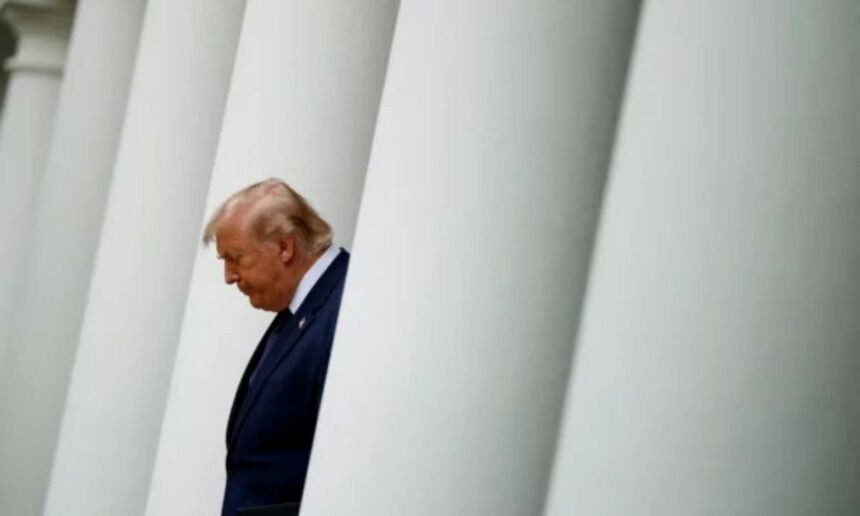
On July 8, U.S. President Donald Trump boarded Air Force One in full view of television cameras as he prepared to leave the NATO summit in Turkey.
But when the large Boeing aircraft took off from Ankara, Trump was reportedly no longer on board. Instead, he had been secretly transferred by a catering truck to a C-32A military aircraft, a modified Boeing 757, which then flew him to RAF Mildenhall in the United Kingdom.
The people who remained aboard Air Force One unknowingly served as decoys and were reportedly unaware that Trump was no longer traveling with them.
Security experts say, however, that such deception tactics are not unusual when protecting a U.S. president.
“It’s very common,” said Ronald Kessler, an author of several books on the Secret Service. He noted that the agency has a long history of using strategies designed to mislead anyone who might seek to harm the president.
Robert McDonald, a former senior Secret Service official with experience protecting U.S. presidents, told the BBC that smaller-scale deception tactics are routinely used during presidential motorcades.
Presidential motorcades typically involve dozens of security and support vehicles, ambulances and vans carrying White House reporters. They also generally include two armored presidential limousines, known as “The Beast.”
While one carries the president, the other travels alongside it as a decoy, with the vehicles sometimes changing positions on the way to their destination.
“We call it the shell game,” said McDonald, who drove one of the presidential vehicles during the George W. Bush administration.
He recalled that even when traveling from Washington to Andrews Air Force Base, the two limousines could switch positions, including beneath an overpass.
Such maneuvers, he said, were carried out away from the view of anyone outside the motorcade. Similar tactics are used to create uncertainty for potential attackers.
Marine One, the presidential helicopter, is also typically accompanied by two other helicopters. The aircraft can change positions during flight, making it more difficult for a potential threat to determine which helicopter is carrying the president.
More sophisticated deception tactics
For high-risk international travel, security measures can become considerably more elaborate.
Paul Eckloff, a former Secret Service agent, said switching the president between aircraft is rare but remains one of the options available to the agency and other executive-protection teams.
“When the president travels to war zones, there are often tactics used to create uncertainty for an adversary about which aircraft or movement he will take,” Eckloff said.
There have been several precedents.
In March 2000, then-President Bill Clinton traveled from India to Islamabad aboard an unmarked executive aircraft that landed behind a decoy aircraft painted in Air Force One colors.
Three years later, the White House announced that President George W. Bush would spend Thanksgiving in Texas, but he instead made a secret trip to Baghdad aboard Air Force One with its lights turned off.
In 2023, President Joe Biden also made a secret trip to Ukraine, accompanied by only one journalist and one photographer.
In those cases, the journalists on board were aware of the deception but were instructed not to report the movements in real time.
Why was Trump moved to another aircraft?
The precise nature of the threat that prompted the latest operation remains unclear.
The Secret Service has not commented on the incident, while the White House has neither confirmed nor denied the details, saying only that it uses every available means to protect the president.
Security experts say that although protection teams prepare contingency plans for a range of scenarios, they must also be capable of improvising when confronted with emerging threats, particularly during international travel.
McDonald said the decision to secretly transfer Trump from Air Force One to another aircraft suggested that authorities regarded the perceived threat as serious.
“That tells me the threat level in Turkey was relatively high,” he said, adding that presidential staff, the Secret Service and the White House Military Office were likely informed immediately.
Marc Polymeropoulos, a former CIA officer with 26 years of experience in Iraq, Afghanistan and covert operations around the world, said the key question was what kind of threat was serious enough to trigger such an elaborate deception operation.
He also questioned whether the government and intelligence community had a responsibility to warn those who remained aboard the original aircraft.
Were the passengers left on Air Force One at risk?
It remains unclear how significant the threat was to the people who stayed aboard Air Force One, or whether they were actually in danger.
Journalists reportedly received repeated instructions to keep the aircraft’s window shades closed. McDonald described that as a “not unusual” security measure indicating that additional precautions were being taken.
He also said the Secret Service has no legal obligation to publicly disclose threats or operational measures used to protect the president and those accompanying him.
Such decisions are ultimately left to the White House and other relevant agencies.
“The Secret Service does not do public relations,” McDonald said, emphasizing that operational secrecy is central to the agency’s mission.
The covert aircraft switch therefore appears to have been part of a broader effort to keep Trump’s movements unpredictable during a period of heightened security concerns, although the exact threat that prompted the operation has not been publicly disclosed.