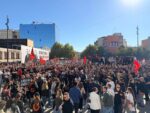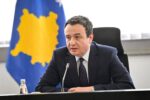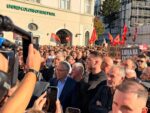
A year after members of Serbia’s elite military police unit, the “Kobre,” fired a shot into the air outside the Serbian Progressive Party (SNS) offices in Novi Sad during a student protest, questions remain over why the unit was deployed at a political gathering and whether former Prime Minister and SNS leader Miloš Vučević should have been there.
The incident took place on August 13, 2025, during one of the most tense confrontations of Serbia’s student-led protests. As clashes erupted between protesters and SNS supporters outside the party’s offices on Bulevar Oslobođenja, a member of the “Kobre” drew his service pistol and fired a shot into the air.
A photograph taken that evening by photojournalist Andrej Hložan, showing members of the unit pressed against the wall of the SNS offices, quickly became one of the defining images of the protests.
The incident also raised questions that remain unresolved a year later: why were members of the Serbian Armed Forces present at a political confrontation outside the headquarters of the ruling party, who ordered their deployment and whether their involvement complied with established procedures.
Why were the ‘Kobre’ protecting Vučević?
Member of the “Kobre” unit Vladimir Brkušanin said after the incident that he had been on official duty and fired one shot into the air after assessing that the lives of himself and his colleagues were in danger.
Then-Defense Minister Bratislav Gašić confirmed that the unit had been assigned to protect a protected person. The director of the Military Security Agency, Đuro Jovanić, said seven members of the Serbian Armed Forces were injured during the incident.
The identity of the protected person was subsequently confirmed by Vučević himself. He said the “Kobre” were protecting him while he was inside the SNS offices with his son Mihailo, Deputy Prime Minister Adriana Mesarović and other party members and supporters.
That immediately raised a further question: on what legal basis was Vučević, who at the time was a former prime minister and SNS president, being protected by a Serbian military unit inside his political party’s headquarters during a protest?
Military analysts subsequently called for clarification over who qualifies for such protection and who makes the decision to deploy the unit.
Did Vučević’s presence create an additional security risk?
According to lawyer Marko Pantić, there was likely a legal basis for protecting Vučević because less than six months had passed since he resigned as prime minister.
Pantić said the right to protection, however, was separate from the question of how that protection was operationally used.
“If that right to protection existed and there was a legal and operational assessment that the person needed protection, that is one thing. But the protected person should adjust their movements to the level of risk and avoid situations in which they could endanger both themselves and the members of the unit protecting them,” Pantić said.
He argued that a protected person should not participate in mass political gatherings where violent clashes are considered possible.
“The person they were protecting should not have been at that gathering, because by doing so he endangered both himself and those men who were protecting him,” Pantić said, adding that Vučević had received protection as a former prime minister but appeared at the protest as a party official.
A criminal case against protesters
While questions surrounding the deployment of the “Kobre” remained unresolved, criminal proceedings were launched against protesters involved in the confrontation.
Six demonstrators were arrested, five of whom were placed in detention and accused of attempting to kill members of the military unit.
The case subsequently raised questions about proportionality and transparency, particularly because the public had not received a clear explanation of who ordered the deployment of the “Kobre” and whether their presence at the political gathering complied with the relevant procedures.
Earlier violence outside SNS offices
The Novi Sad incident came months after another confrontation outside SNS offices that became a symbol of violence during Serbia’s student protests.
In late January 2025, four SNS activists were accused of attacking a group of students who were putting up posters calling for protests. One female student suffered serious injuries, including a fractured jaw.
The incident contributed to Vučević’s resignation as prime minister, while Novi Sad Mayor Milan Đurić also stepped down.
The four SNS activists were later pardoned by Serbian President Aleksandar Vučić on July 2, 2025, bringing the criminal proceedings against them to an end.
The decision generated further criticism because the pardon came before the criminal proceedings had reached a final judgment.
Questions over the presidential pardons
Pantić said the president formally had the legal authority to issue a pardon but questioned how the power was used in this case.
He described the intervention as a serious misuse of the institution of presidential pardon, arguing that the power is generally intended to provide relief in exceptional circumstances involving convicted individuals.
The lawyer also questioned the decision to intervene while the proceedings were still ongoing.
“The president of the Republic had the legal right to do it, but it is much rarer for a president to intervene while proceedings are still ongoing,” Pantić said.
He argued that the public should also receive an explanation from the Justice Ministry about the basis on which the proposal for the pardons was submitted to the president.
“The girl suffered injuries, and this situation contributes to an atmosphere of legal insecurity and sends a message that SNS members can do the same things as those men and that someone will come to their aid,” Pantić said.
A year after the “Kobre” fired a shot outside the SNS offices, the incident remains part of the broader debate over the relationship between Serbia’s ruling party, state institutions and security structures during the country’s prolonged student protests.
As Pantić put it: “All of this is much more politics than law. And where politics enters, law leaves.”