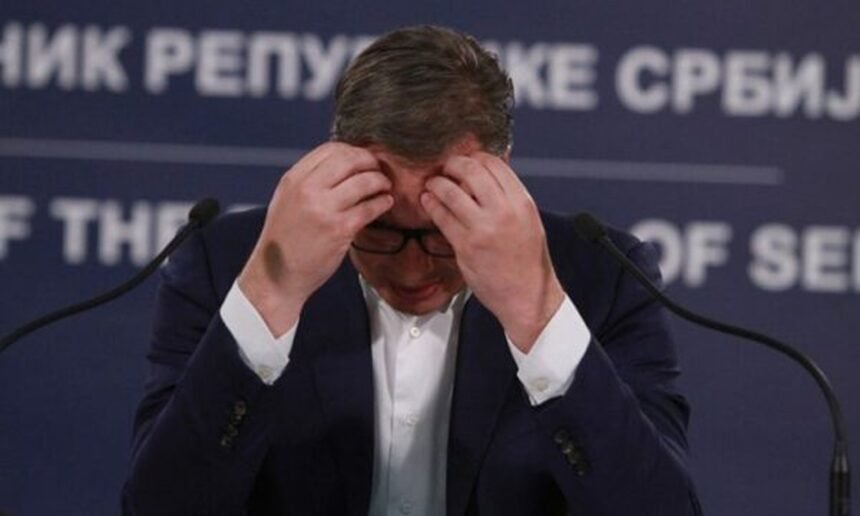
Serbian Progressive Party (SNS) councillors in the Užice City Assembly voted against an opposition proposal to organize an official welcome for President Aleksandar Vučić, despite the initiative being designed as a political joke aimed at highlighting what opposition councillors describe as the ruling party’s automatic rejection of their proposals.
The vote took place during Monday’s session of the local assembly, ahead of Vučić’s planned visit to Užice on August 29 as part of his tour of cities and villages across Serbia.
According to footage released from the session, SNS councillors appeared confused during the vote, with some raising their hands and then lowering them while looking toward colleagues, apparently uncertain whether they were expected to support or reject the proposal.
The initiative was submitted by Dragan Aleksić of the citizens’ group “Užička Republika,” who proposed establishing an assembly committee to organize a ceremonial welcome for the Serbian president.
The final vote saw 14 opposition councillors support the proposal, while 19 members of the ruling majority voted against it. One SNS councillor abstained.
The president of the Užice Assembly subsequently argued that the proposal was not within the assembly’s jurisdiction.
Opposition says the proposal was designed as a political trap
Marko Radojičić, head of the “Užička Republika” councillor group, said the initiative was deliberately conceived as a humorous response to what he described as the ruling majority’s systematic rejection of opposition amendments.
“Opposition councillors submitted more than 50 amendments, all of which were rejected with rather simplistic and not particularly realistic explanations,” Radojičić told Nova.
The opposition then decided to use Vučić’s upcoming visit to create a deliberately ironic proposal.
“Since the president of the Republic had announced that he would be visiting our city on Saturday, we came up with the idea of proposing that the assembly form a group of councillors who would welcome the president on behalf of the assembly,” Radojičić said.
He said the reaction of SNS councillors was the most revealing part of the episode.
“It was extremely interesting to watch their reactions, how they cautiously raised their hands without knowing whether to vote for or against,” he said.
Vladan Sinđić, an Užice councillor from the Green-Left Front, confirmed that the proposal was intended as a provocation designed to expose what the opposition considers an automatic voting pattern.
“When the individual vote came, the Progressives remained silent and confused. Some voted in favor, some raised their hands and then lowered them, and some did not even know how to vote,” Sinđić said.
Opposition alleges ruling majority routinely rejects its own ideas
The episode has also prompted opposition councillors to accuse the SNS majority of rejecting proposals simply because they originate from political opponents.
Radovan Novaković of “Užička Akcija” said this was not the first time ruling councillors had voted against an initiative that had previously been advocated by the ruling party itself.
He cited a campaign promise concerning the construction of a road as an example. Novaković said he later submitted an amendment to the city budget proposing funding for the same project, only for SNS councillors to vote against it.
“I told them: ‘This is your proposal, not mine. You promised it,’” Novaković said.
According to the opposition, the incident in the Užice Assembly therefore illustrates a broader political practice in which proposals are assessed according to who submitted them rather than their substance.
Large turnout expected for Vučić’s visit
Meanwhile, opposition councillors say a large gathering is expected in Užice on Saturday, with buses reportedly being organized from the city, surrounding municipalities and Bosnia and Herzegovina.
Novaković claimed that around 300 buses were expected to arrive, although these figures were not independently verified in the report.
He also alleged that recent public-opinion research in Užice and Novi Sad showed low levels of support for Vučić, attributing this to developments over the past year.
The opposition argues that the planned gathering is unlikely to significantly improve the president’s standing in the city.
There had reportedly been no reaction from the SNS leadership in Belgrade at the time of the report. Opposition councillors said they would not be surprised if the incident attracted attention from the party leadership, particularly because the proposal resulted in the ruling majority voting against an initiative explicitly framed around welcoming Vučić himself.