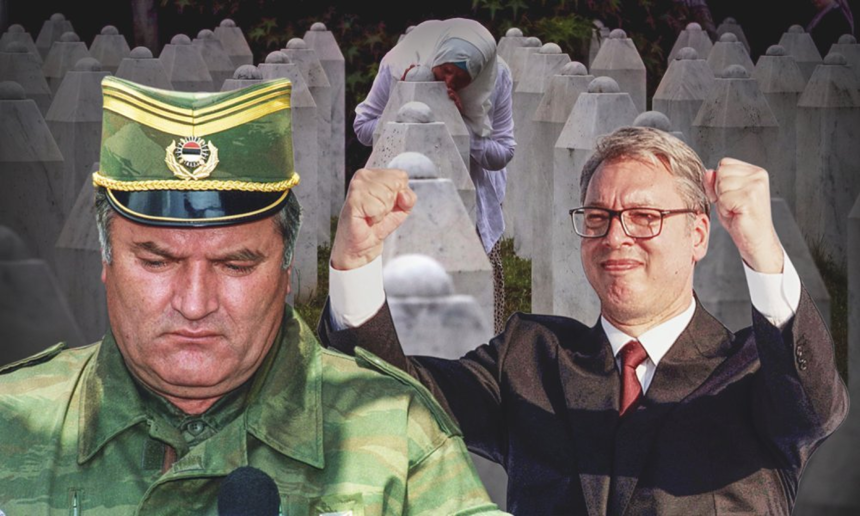
Ratko Mladić is dead. But the political machinery that turned him into a nationalist icon is very much alive.
And nowhere is that contradiction more glaring than in the career of Aleksandar Vučić.
Mladić died while serving a life sentence after being convicted of genocide, crimes against humanity and war crimes. He was held responsible for some of the darkest atrocities of the Bosnian war, including the Srebrenica genocide, in which more than 8,000 Bosniak men and boys were killed.
Yet Serbia is not simply burying him.
It is debating how much honor to give him.
Serbian Justice Minister Nenad Vujić announced that Mladić would receive state and military honors. Vučić himself avoided explicitly endorsing those honors, but said the Serbian state would organize the burial and ensure that the family’s wishes were respected.
And then there is the president’s own history.
Before Vučić became “European,” he was putting Mladić’s name on Belgrade streets
In 2007, Aleksandar Vučić was not some distant observer of Mladić glorification.
He was leading it.
As a senior official of Vojislav Šešelj’s Serbian Radical Party, Vučić participated personally in an action in Belgrade in which posters reading “Bulevar Ratka Mladića” were placed over the boulevard that was being renamed after assassinated Serbian Prime Minister Zoran Đinđić.
Contemporary reports explicitly document Vučić’s involvement. Radio Free Europe reported that he personally put up the sign. B92 likewise reported that Vučić addressed the crowd and personally pasted one of the posters.
Think about the symbolism.
Zoran Đinđić represented a democratic, European Serbia. Ratko Mladić represented the machinery of war and ethnic cleansing.
And Vučić chose to put Mladić’s name over Đinđić’s.
That was not an accident.
That was politics.
The nationalist past has not disappeared. It has simply been rebranded.
Today, Vučić presents himself to Brussels as a pragmatic European statesman.
He speaks about stability.
He speaks about peace.
He speaks about Serbia’s European future.
But when the man convicted of genocide dies, Vučić does not use the moment to unequivocally condemn his crimes.
Instead, he attacks the Hague tribunal as “anticivilizational” and accuses it of wanting Mladić to die behind bars.
That is an extraordinary political choice.
The question should have been:
What did Ratko Mladić do?
Instead, Vučić’s message becomes:
What did The Hague do to Ratko Mladić?
That reversal tells its own story.
A convicted genocidaire gets dignity. What do his victims get?
This is where Serbia’s hypocrisy becomes impossible to disguise.
The international tribunal convicted Mladić of genocide and other crimes.
The victims have spent decades burying their dead, searching for remains and demanding recognition.
But the Serbian state is now discussing how to give the convicted war criminal a “dignified” farewell.
Thousands have gathered to honor him.
His image continues to appear in nationalist propaganda.
And the political establishment has been forced to debate whether a man convicted of genocide deserves military and state honors.
So where is the dignity for the victims?
Where is the state ceremony acknowledging Srebrenica?
Where is the unequivocal political statement saying:
“Ratko Mladić was not a hero. He was convicted of genocide.”
Silence speaks loudly.
Vučić wants the benefits of Europe without the responsibility of confronting Serbia’s past
This is the real problem.
Belgrade wants EU membership.
It wants European money.
It wants European political legitimacy.
It wants to be treated as a responsible European power.
But Europe cannot be expected to applaud Serbia’s European ambitions while Serbia simultaneously turns a convicted war criminal into a national symbol.
You cannot demand European integration while glorifying the people convicted of the crimes that Europe spent decades trying to bring to justice.
You cannot ask Europe to forget Srebrenica while Serbia remembers Mladić as a hero.
And you certainly cannot sell yourself as a modern European leader while your own political past includes personally putting Mladić’s name on the streets of Belgrade.
Vučić’s political transformation has a credibility problem
Vučić wants the world to believe that the Radical Party politician of the 1990s and 2000s is gone.
But history is inconvenient.
It does not disappear because a politician changes his suit.
It does not disappear because he starts using the word “Europe.”
And it certainly does not disappear because Brussels receives another carefully worded speech about reform and stability.
The photographs remain.
The newspaper archives remain.
The statements remain.
And the victims remain.
The 2007 image of Vučić putting up a sign bearing Mladić’s name is particularly damning because it destroys the convenient fiction that today’s controversy has nothing to do with yesterday’s Serbia.
It has everything to do with it.
The real question is: has Serbia changed—or has Vučić simply learned to speak European?
Serbia is now confronted with a choice.
It can finally draw a line under the ideology that produced the wars of the 1990s.
Or it can continue sanitizing it.
It can acknowledge the victims.
Or it can celebrate their executioner.
It can confront genocide.
Or it can hide behind euphemisms like “general,” “hero,” “dignified funeral” and “military honors.”
And Vučić can finally condemn the political glorification of Mladić.
Or he can continue pretending that history began when he became president.
But it didn’t.
His past is documented. His political record is documented. His involvement in the 2007 Mladić poster campaign is documented. And his current reaction to Mladić’s death is being documented too.
Ratko Mladić has died.
But the question he leaves behind is much bigger than his grave.
Can Serbia become genuinely European without confronting the ideology that once made men like Mladić into heroes?
And perhaps the most uncomfortable question of all:
Can Aleksandar Vučić condemn the glorification of Ratko Mladić without first confronting the man he himself was when he helped put Mladić’s name on Belgrade’s streets?
Because Europe does not need another Serbian rebranding campaign.
It needs accountability.
And the victims deserve more than a funeral for the man who helped destroy their lives.
They deserve the truth.