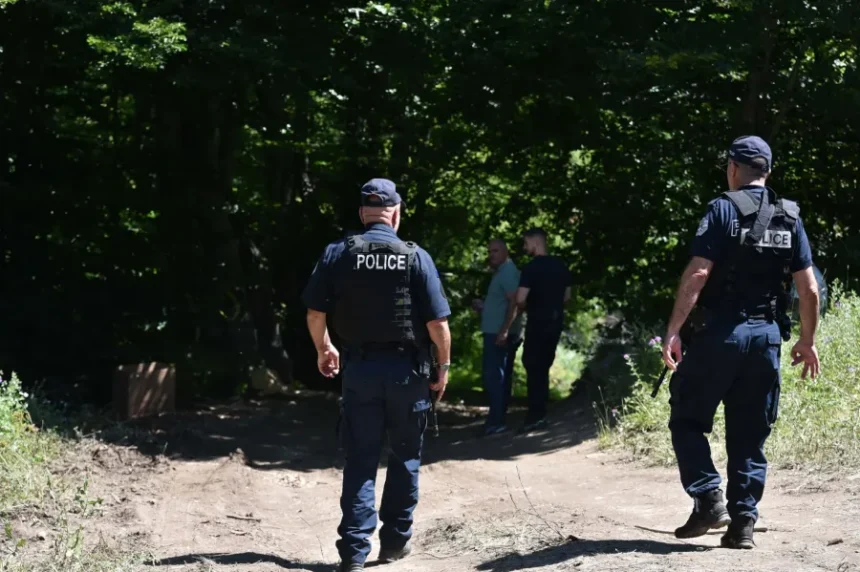
New details have emerged about excavations at three locations in the municipality of Zubin Potok, where human remains believed to belong to at least 23 people missing since the Kosovo War have been discovered.
Agron Limani, head of Kosovo’s Government Commission on Missing Persons, said investigations and searches for the missing individuals had been conducted previously, but authorities lacked sufficient information to identify the precise locations of the suspected burial sites.
According to Limani, authorities this time obtained credible information from individuals who had knowledge of the locations of the graves, allowing investigators to identify three specific sites — two in Kalludër and one in Jabukë.
“At the first mass grave, the remains of 13 people were found, at the second six, and at the third seven, completing a total of 23 skeletal or human remains,” Limani said.
He made the remarks during a public discussion organized on Monday by Pro Peace Kosovo and Integra, in cooperation with the Barabar Center, to mark the International Day of the Victims of Enforced Disappearances.
Forensic identification process to begin
The Institute of Forensic Medicine is expected to begin the process of identifying the remains through DNA analysis and anthropological examinations.
Dion Haliti, an official at the Institute of Forensic Medicine, said the remains would undergo further forensic examination after the initial results are obtained. Families would then be informed once the identities of their relatives are established.
Autopsies will also be conducted to determine injuries to the bones, as well as the cause and manner of death. The findings will subsequently be submitted to the State Prosecutor for further criminal proceedings.
Haliti said that, provided there are no difficulties in extracting DNA profiles from the bone samples, the identification process could take up to three months.
The Ministry of Justice has also called for the discovery to contribute not only to identifying the victims, but also to establishing responsibility for crimes committed during the war.
Baki Svirca said the discovery was significant for Kosovo society as well, because it could help document what happened during the conflict and provide answers to families who have waited for information about their missing relatives for more than two decades.
The group known as the “Mitrovica Group of Intellectuals” consisted of 23 people who had been missing since April 1999. Among them were doctors, professors, lawyers and other professionals.
The discovery of their remains could provide long-awaited answers to their families while potentially opening the way for further investigations into the circumstances surrounding their deaths and the concealment of their remains.