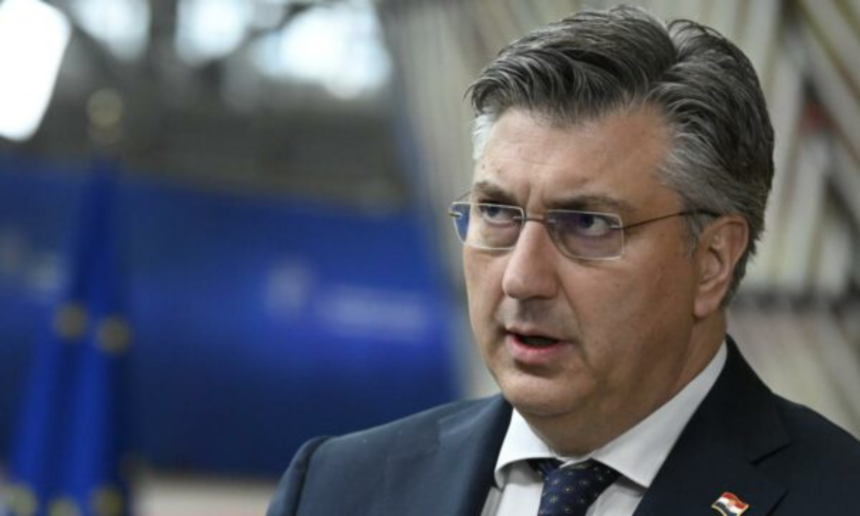
Croatian Prime Minister Andrej Plenković has welcomed the stronger reaction from European Union leaders to the funeral of convicted war criminal Ratko Mladić in Belgrade, saying he personally pushed for a more forceful response from Brussels.
Plenković said he had criticized the lack of an immediate and sufficiently strong reaction from EU institutions following the funeral, which was attended by several senior Serbian officials and other political figures.
“I saw that there was no reaction. I saw a completely inadequate reaction at the level of the spokesperson,” Plenković said.
He said that, following the events surrounding the funeral, he contacted Croatia’s permanent representative to the European Union and instructed her to raise the issue directly with the offices of senior EU officials.
“I gave her the task of contacting the offices of the President of the Commission, the President of the European Council and the High Representative for Foreign Affairs and Security Policy,” Plenković said.
He pointed to the subsequent statements by European Commission President Ursula von der Leyen, European Council President António Costa and other EU officials as evidence that his intervention had produced a stronger response.
“And as you saw, they all reacted today. That is good. And they should have done so yesterday as well,” Plenković said.
The Croatian prime minister’s comments come amid growing criticism in the EU over the public honoring of Mladić, who was convicted by the International Criminal Tribunal for the former Yugoslavia and sentenced to life imprisonment for genocide, crimes against humanity and war crimes committed during the 1992–1995 war in Bosnia and Herzegovina.
The funeral has triggered diplomatic and political reactions across the region, with critics arguing that the participation of Serbian government officials and representatives of other institutions amounted to an implicit state endorsement of the commemoration.
EU leaders have stressed that glorification of convicted war criminals and denial or minimization of genocide are incompatible with European values and Serbia’s path toward EU membership.
The episode has also intensified scrutiny of Brussels’ broader approach toward Serbia, particularly over concerns about democratic standards, regional reconciliation and Belgrade’s alignment with EU foreign-policy positions.