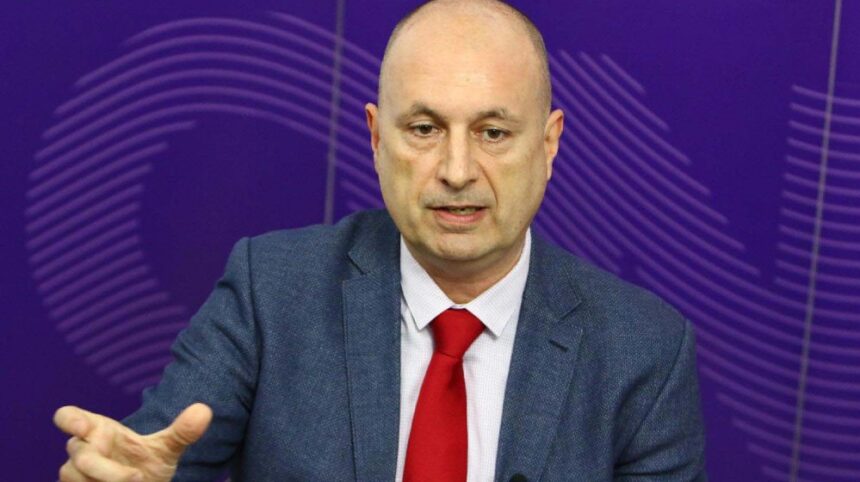
Vladimir Međak, vice president of the European Movement in Serbia, has called for a change in the European Union’s approach toward Belgrade following the controversy surrounding the funeral of convicted war criminal Ratko Mladić.
Speaking to FoNet, Međak said the most effective measure would be to expel the Serbian Progressive Party (SNS) from the European People’s Party (EPP), arguing that such a move would target the political actor responsible rather than Serbia as a state.
“The most useful measure for Serbia would be the expulsion of SNS from the European People’s Party, because that best targets the responsible actor,” Međak said.
He said the European Commission could propose that the Council of the EU formally suspend Serbia’s accession negotiations, but argued that such a decision would be counterproductive because it could make European integration more difficult for a future democratic government in Serbia.
“An official suspension would be a very wrong decision,” Međak said, explaining that after a change of government, a new administration would first have to formally unblock the negotiations, leaving every EU member state in a position to reassess Serbia.
Instead, he identified the withdrawal of the European Commission’s proposal to open Cluster 3 as a more targeted measure. The Commission proposed opening the cluster in June, and Međak said withdrawing that recommendation would effectively halt further progress in the accession process without formally suspending negotiations.
“Every further step has to be made at the Commission’s proposal. What would be quite sufficient is for the European Commission to withdraw its proposal. At that moment, literally everything stops,” he said.
Međak also pointed to the possibility of withholding funds under the EU’s Growth Plan for the Western Balkans if the Commission determines that Serbia has not met the conditions required for disbursement.
“The Commission can say that the conditions for the payment of money from the Growth Plan have not been met, and at that moment the Growth Plan stops,” he said, noting that members of the European Parliament have also called for such measures.
Pressure on SNS rather than Serbia
Međak argued that expelling SNS from the EPP would be particularly significant because it would place political responsibility directly on the ruling party rather than punishing Serbian citizens or future governments.
He stressed the political links between the EPP and European institutions, noting that European Commission President Ursula von der Leyen has a prominent role within the broader EPP political family, while EPP President Manfred Weber is responsible for SNS membership in the organization.
“The European Commission works with Serbia as an actor, while the EPP works with the actor behind Mladić’s funeral. If you want to target the source of the problem, then that is the EPP,” Međak said.
At the same time, he said he currently lacked confidence that von der Leyen would take such measures.
Međak criticized the European Commission’s initial response to Mladić’s funeral, particularly the initial characterization that it was not a state funeral. He said the Commission later changed its position and referred to it as a “partial state funeral,” which he described as “complete nonsense.”
He said the rapidly changing reactions from EU member states demonstrated that Mladić’s funeral had evolved into a broader diplomatic issue.
The United Kingdom, although no longer an EU member, summoned Serbia’s ambassador for consultations, while Sweden and Germany’s Foreign Ministry also issued critical statements, according to Međak.
“Things are literally changing day by day. Yesterday’s events change the events of the day before yesterday. Things are changing and I cannot guarantee what will happen,” he said.
Von der Leyen’s planned Serbia visit
Međak also addressed the possibility of von der Leyen visiting Serbia during the upcoming election campaign.
He noted that EU Enlargement Commissioner Marta Kos had already canceled her planned visit to Belgrade following the controversy over Mladić’s funeral, while questioning whether von der Leyen would take a similar step.
“Marta Kos canceled it because she has a clear moral compass. I am not sure about Ursula von der Leyen. I believe there is pressure for her to cancel. Members of the European Parliament have written to her asking her to cancel,” Međak said.
He argued that von der Leyen should not visit Belgrade in the middle of the election campaign and that the European Commission should withdraw its recommendation to open Cluster 3.
“For starters, Ursula von der Leyen should not come to Belgrade in the middle of the election campaign, the Commission should withdraw its recommendation to open Cluster 3 and, of course, it should not provide any money before the elections. Everything after the elections is completely fine,” Međak said.
His comments come amid growing criticism in Brussels and several European capitals over the participation of Serbian officials and state-linked institutions in events surrounding Mladić’s funeral, and increasing debate over whether the EU should impose political or financial consequences on Belgrade.