Albanian Prime Minister Edi Rama’s lack of an immediate public reaction to Aleksandar Vučić’s reported defeat in Serbia’s October 25 parliamentary elections has prompted debate among political analysts, who question how the result could affect Tirana’s relations with Belgrade and its approach to Kosovo.
According to projections cited in the report, the student-backed electoral list secured 51.5% of the vote, compared with 40.4% for Vučić’s Serbian Progressive Party (SNS), according to election-monitoring organization CRTA. The opposition-backed list was projected to win between 135 and 140 seats in Serbia’s 250-member parliament, potentially opening the way for a government without Vučić’s ruling bloc.
The election was widely viewed as a test of Vučić’s leadership, which has dominated Serbian politics since 2012. The student movement emerged following mass protests over the November 2024 collapse of a railway station canopy in Novi Sad, a tragedy that killed 16 people and fueled accusations of corruption and institutional negligence.
The electoral process was also marked by allegations of irregularities. CRTA reported suspected vote-buying, voter intimidation and ballot photography, while media outlets reported attacks on election observers and journalists.
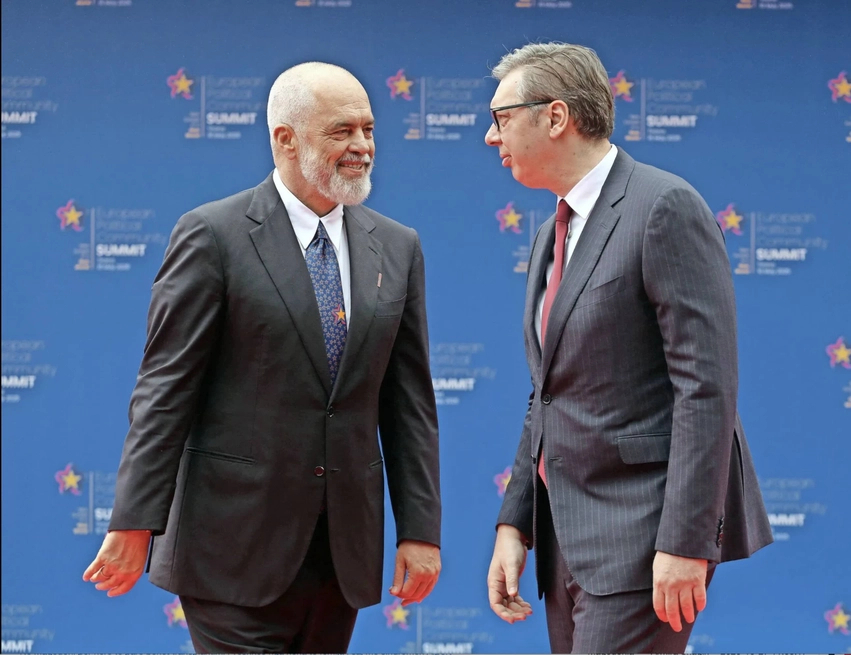
Against this backdrop, attention has turned to Rama’s relationship with Vučić, particularly their cooperation through the Open Balkan initiative and other regional political projects.
Although Rama had not personally commented on the result at the time of the original report, Albania’s Ministry for Europe and Foreign Affairs issued a statement congratulating the student-backed list and Albanians in the Preševo Valley. The ministry also emphasized the importance of normalizing relations between Kosovo and Serbia.
Dosti: Vučić’s defeat could affect Rama’s regional strategy
Political analyst Adriatik Riza Dosti argued that Vučić’s defeat could weaken a close political partnership on which Rama had relied.
Dosti claimed that the Serbian result could have consequences for Rama, who is also facing student protests in Albania. He predicted that the political changes in Serbia could eventually be followed by changes in Albania, although he provided no evidence establishing a direct link between the two developments.
Asked whether Rama’s longstanding political relationship with Vučić suggested that Tirana had prioritized cooperation with Belgrade over Kosovo’s interests, Dosti argued that Albania’s official policy had historically favored close relations with Serbia.
He characterized the partnership between Rama and Vučić as detrimental to Kosovo and said the political changes in Serbia could force a reassessment of regional cooperation.
Dosti nevertheless expressed doubt that Rama would necessarily adopt a more favorable approach toward Kosovo or significantly rebalance his relationship with Kosovo Prime Minister Albin Kurti.
He argued that Albania should not remain dependent on any particular regional political arrangement, while acknowledging that the consequences of the longstanding Rama-Vučić partnership could persist.
Maraj links Rama’s silence to wider political projects
Political analyst Milazim Maraj offered a similar interpretation, arguing that Rama’s lack of an immediate personal reaction could indicate difficulties for projects developed through cooperation with Vučić.
Maraj suggested that the Serbian election result could have repercussions in Albania, particularly for political and economic arrangements involving regional partners. He also referred to alleged links between the leaders and broader geopolitical interests, including those associated with Richard Grenell and Russian President Vladimir Putin.
These claims were presented as Maraj’s interpretation and were not substantiated with specific evidence in the report.
Maraj cautioned against assuming that a change in Serbia’s political leadership would automatically produce a more conciliatory policy toward Kosovo. He argued that a new government in Belgrade could make gestures welcomed by the European Union and the United States while continuing to press Kosovo on unresolved issues, including the proposed Association of Serb-majority municipalities.
He warned that such developments could increase pressure on Kosovo and affect Albanians in the Preševo Valley and North Macedonia.
Maraj also questioned whether Rama would use the political changes in Serbia as an opportunity to reconsider his approach toward Kosovo.
In his assessment, there was no clear indication that the Albanian prime minister intended to change course or reconsider his support for regional initiatives that have been criticized by some political figures in Kosovo.
The future of Albania-Serbia relations
The debate highlights broader questions about the future of regional cooperation following the reported election result in Serbia.
Rama and Vučić have maintained close political contacts and promoted initiatives intended to strengthen economic cooperation across the Western Balkans. However, critics have argued that these arrangements have not adequately addressed Kosovo’s concerns or the wider political disputes between Prishtina and Belgrade.
Whether Serbia’s reported electoral shift will lead to a substantial change in regional policy remains uncertain. The composition and priorities of any new government in Belgrade will be important factors in determining the future of relations with Albania and Kosovo.
For now, the analysts’ comments reflect competing expectations about what the election could mean for the region, rather than evidence that existing political arrangements have already collapsed.
Albania’s official response, meanwhile, has been conveyed through its foreign ministry, which congratulated the student-backed list and emphasized the need to normalize relations between Kosovo and Serbia.