A Year Defined by Impunity, Political Protection, and Systemic Abuse
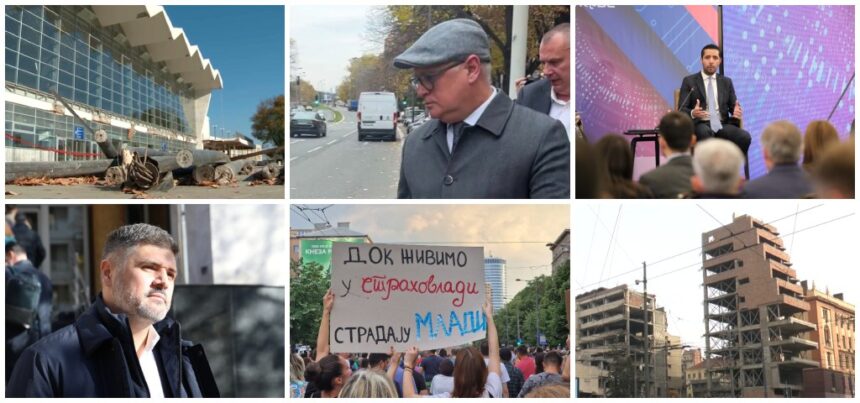
The year 2025 was marked by a series of major crime, corruption, and institutional abuse scandals, revealing deep-rooted problems in Serbia’s political, judicial, and security systems. Two cases, colloquially known as “Nadstrešnica” and “Generalštab”, came to symbolize the broader collapse of accountability.
The “Nadstrešnica” Case: Death, Protests, and Repression
The collapse of a canopy at the Novi Sad railway station, which killed 16 people, triggered mass student and civic protests across Serbia. Demonstrators demanded accountability for corruption and negligence that led to the tragedy.
Instead of justice, the response was marked by:
- Police brutality and arbitrary arrests
- Illegal surveillance by the Security Intelligence Agency (BIA)
- Criminal and misdemeanor charges used to intimidate protesters
- Violence by regime supporters, who were later pardoned by President Aleksandar Vučić
Several high-profile figures close to the government were spared responsibility, including:
- Former construction minister Goran Vesić, whose case was dropped
- Vučić’s godfather Nikola Petrović, whose cocaine-positive McLaren crash case expired due to statute limitations
- SNS activists who violently assaulted students, later personally pardoned by the president
Illegal Use of a Sound Cannon
One of the most disturbing episodes occurred during a major protest in Belgrade on March 15, when authorities allegedly used a sound cannon, a weapon banned under Serbian law, causing mass disorientation, nausea, and potential permanent hearing damage.
Officials initially denied possession of the device, only to later admit they owned it but claimed it was never used—a statement contradicted by video evidence and witness testimonies.
The European Court of Human Rights later warned Serbia that such devices must not be used against civilians.
“Sky” Messages and Links Between Politics, Business, and Organized Crime
Investigative journalists from KRIK revealed encrypted Sky ECC messages exposing internal conflicts within the ruling Serbian Progressive Party (SNS) involving:
- Senior politicians
- Regime-linked businessmen
- Figures from organized crime
The messages described multi-million-euro kickbacks, illicit deals in the energy sector, and direct references to President Vučić’s brother, Andrej Vučić, as a figure wielding decisive influence over government appointments and strategic industries—claims the president publicly denied.
In a landmark ruling, Serbian courts accepted Sky messages as legal evidence for the first time, marking a potential turning point in organized crime prosecutions.
Judiciary Under Pressure and Selective Justice
Throughout 2025:
- Trials against powerful figures stalled or collapsed
- Convictions were overturned or delayed
- Cases involving political allies quietly expired
Notable examples include:
- The retrial of former Interior Ministry official Dijana Hrkalović
- The stagnation of the “Jovanjica” marijuana plantation case
- The release of convicted crime boss Zoran Jotić Jotka despite a lengthy sentence
At the same time, journalists, activists, and students faced record levels of intimidation, including:
- 371 attacks and threats against journalists
- SLAPP lawsuits aimed at silencing investigative media
- Police acting as a source of danger rather than protection
The “Generalštab” Case: Culture, Corruption, and Foreign Interests
The government passed a lex specialis law allowing the demolition of the General Staff complex, a protected cultural landmark, paving the way for a luxury development project involving Jared Kushner, son-in-law of U.S. President Donald Trump.
The case resulted in:
- Forgery charges
- An indictment against Culture Minister Nikola Selaković
- Testimony implicating senior officials, including Siniša Mali and Goran Vesić
Despite Kushner later withdrawing from the project, authorities described the move as a “temporary setback”, not an abandonment.
Security Services, Surveillance, and Russian Influence
Investigations revealed that:
- BIA illegally wiretapped opposition parties, activists, and journalists
- Spyware was planted on citizens’ phones
- Russian-linked paramilitary training camps operated on Serbian territory
- Hundreds of Russian nationals connected to security services and sanctioned businesses received Serbian citizenship under “national interest” exemptions
A Pattern, Not Isolated Incidents
Taken together, the events of 2025 paint a clear picture:
- Political power shields allies from accountability
- Institutions serve the ruling elite rather than the public
- Corruption, organized crime, and state structures increasingly overlap
- Repression replaces reform when citizens demand justice
The year ended with more questions than answers, and with public trust in institutions at historic lows.