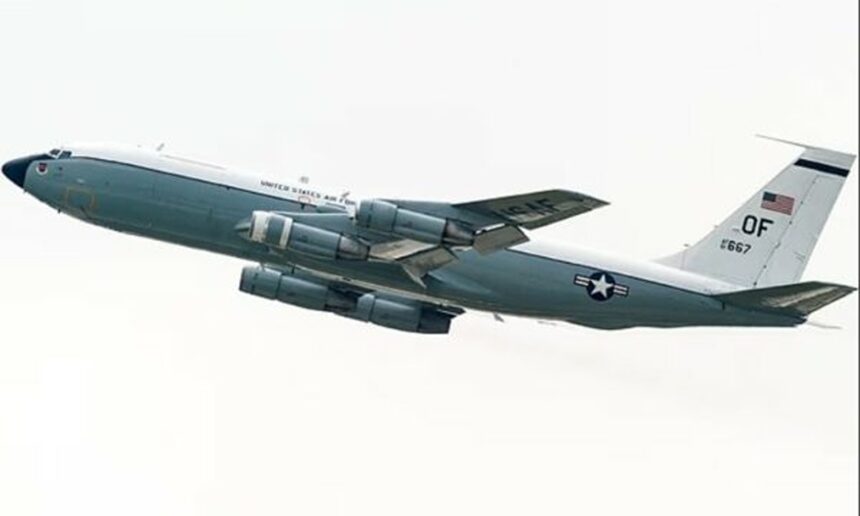
The U.S. Air Force’s Boeing WC-135R Constant Phoenix, an aircraft used to detect nuclear activity, was observed flying across several states on Thursday, raising concern among observers.
Flight data shows that the so-called “nuclear-sniffer” took off from Nebraska, circled over South Dakota, and made an arc near Fargo, North Dakota. The aircraft is currently operating over Rapid City, South Dakota, continuing its mission.
The WC-135R’s purpose is to collect atmospheric samples to detect and identify radioactive debris from nuclear explosions, supporting arms control treaty verification and national security by monitoring nuclear detonations and radioactive fallout.
This flight comes as the U.S.-Russia nuclear treaty, the New START Treaty, is set to expire on February 5, causing concern among observers.
Although U.S. officials have not confirmed the reason for this mission, domestic flights of the WC-135R are often used for crew training, equipment calibration, or monitoring background radiation.
However, on Thursday, Northrop Grumman also conducted the first test of an intercontinental ballistic missile (ICBM) test vehicle, coinciding with the WC-135R flight. This test vehicle uses parts from decommissioned nuclear missiles but is unarmed and cannot carry a nuclear payload, serving only as a testing platform for U.S. missile defense systems.
Robin Heard, Director of Targets and Interceptors at Northrop Grumman, said:
“By integrating digital technology at every stage of the ICBM target renewal and new integration processes, we have improved field operations, operational safety, and cost-effectiveness for our clients. The efficiency identified during the first flight of this target will positively influence future tests.”
It is unknown whether the WC-135R flight is connected to the ICBM test.
The WC-135R is specially modified with an atmospheric collection system that allows the crew to detect radioactive clouds in real time. It is equipped with external filters to capture particles and a compression system to collect full-air samples for analysis.
The flight is operated by the 45th Reconnaissance Squadron crew at Offutt Air Force Base, Nebraska, while specialized equipment operators are assigned to Detachment 1 of the Air Force Technical Applications Center, also at Offutt.
The Constant Phoenix program dates back to September 16, 1947, when General Dwight D. Eisenhower tasked the Army Air Forces with detecting atomic explosions worldwide.
In a historic September 1949 mission, a WB-29 aircraft flying between Alaska and Japan collected fallout from Russia’s first atomic test—an event initially considered impossible until mid-1950.
Over the decades, aircraft such as the WB-50 and later the WC-135 replaced earlier models, becoming the cornerstone of U.S. airborne nuclear detection. Atmospheric sample collection missions have included the Far East, the Indian Ocean, the Bay of Bengal, the Mediterranean, polar regions, and the coasts of South America and Africa. The WC-135W monitored radioactive fallout from Chernobyl in 1986.
Today, the WC-135 fleet continues to support the 1963 Nuclear Test Ban Treaty, which prohibits nuclear tests on land, maintaining these aircraft as the U.S.’s sole airborne nuclear collection platform.
Thursday’s flight triggered reactions on social media, with users referencing the impending expiration of the U.S.-Russia nuclear treaty.
The New START Treaty, signed on April 8, 2010, was the eighth agreement between the two countries. In September, Russian President Vladimir Putin proposed a 12-month extension for both sides to comply with the New START limits, which cap deployed nuclear warheads at 1,550 per country.
U.S. President Donald Trump has yet to give an official response, and Western security analysts remain divided on the wisdom of accepting Putin’s proposal.