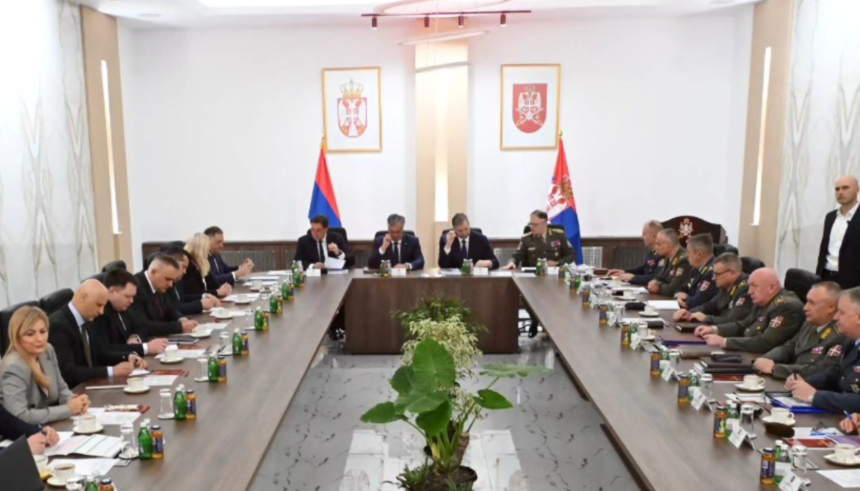
A high-level military briefing convened by Aleksandar Vučić at the Banjica 2 barracks in Belgrade has sparked renewed concerns among analysts about Serbia’s strategic direction and regional security dynamics.
The meeting brought together Serbia’s top military leadership, including Defense Minister Bratislav Gašić and Chief of the General Staff General Milan Mojsilović. Notably, it was also attended by senior political figures from Republika Srpska, including Milorad Dodik and Željka Cvijanović.
Observers note that such a gathering—held within Serbian military infrastructure and involving leadership from Republika Srpska—falls outside the framework established by the Dayton Peace Agreement, which governs Bosnia and Herzegovina’s post-war constitutional order.
Expansion of Military Capabilities
Following the briefing, Vučić outlined plans to accelerate the modernization of Serbia’s armed forces. These include the development of robotic military units, expanded production of drones, and the formation of specialized reconnaissance teams designed to support precision targeting systems.
He emphasized the need for increased defense readiness, citing what he described as a more complex regional security environment. In particular, he pointed to a trilateral cooperation framework involving Pristina, Tirana, and Zagreb as a key factor behind Serbia’s accelerated military investments.
Controversial Statements and Ethnic Framing
Dodik’s remarks during the event have drawn particular attention. He characterized the regional cooperation between Kosovo, Albania, and Croatia as a broader alignment “against the Serbian people,” extending his claims to include political actors within Bosnia and Herzegovina.
Analysts warn that such rhetoric—framing security concerns in ethnic rather than state-based terms—could contribute to rising tensions in the Western Balkans.
Questions Over Strategic Intent
Security experts have also raised questions about the nature of Serbia’s military procurement, including long-range missile systems and loitering munitions. According to analysts, these capabilities are typically associated with offensive operations rather than purely defensive strategies.
At the same time, Serbia maintains that its military buildup is aimed at deterrence and preserving neutrality, a policy it continues to emphasize in both regional and international forums.
Regional and Historical Context
The developments come amid heightened geopolitical uncertainty and ongoing debates about stability in Southeast Europe. Comparisons have been drawn by some observers to patterns seen in the years preceding the conflicts of the 1990s, though others caution against direct parallels.
The involvement of Republika Srpska leadership in Serbia’s security discussions, combined with intensified military development and increasingly sharp political rhetoric, has nonetheless prompted calls for closer international monitoring and diplomatic engagement.
While no immediate escalation is evident, analysts agree that the evolving dynamics warrant careful attention as the region navigates a complex and sensitive security environment.