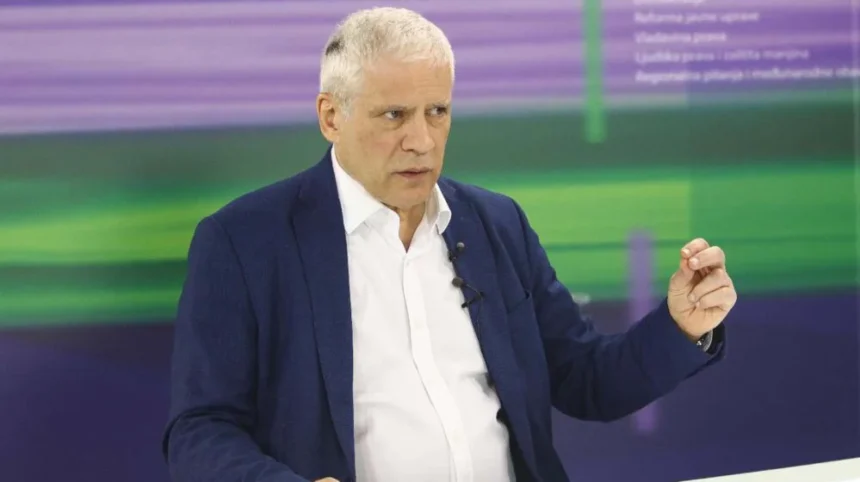
BELGRADE – Former Serbian President Boris Tadić has questioned the reliability of public opinion polls and warned the opposition against becoming overconfident ahead of expected parliamentary elections, arguing that President Aleksandar Vučić is already shaping the political narrative for the upcoming vote.
Speaking on Nova S television’s Među nama program, Tadić, who now leads the Social Democratic Party (SDS), said Vučić’s recent rhetoric is aimed at consolidating support among his core electorate.
“Vučić is creating an atmosphere for elections. Above all, he is addressing his own voters—those who have always been inclined to trust him—and he wants to create a paranoid atmosphere in society, suggesting that someone is threatening the country’s constitutional order,” Tadić said while commenting on the case involving military analyst Aleksandar Radić over his claims about the alleged use of a sonic weapon during last year’s protests.
According to Tadić, the government’s focus on selected political topics is part of a broader election strategy by the ruling Serbian Progressive Party (SNS) to strengthen its support base.
He argued that opposition supporters are generally less loyal than SNS voters and are more likely to change their political preferences or abstain from voting.
“Opposition supporters often overlook the fact that, after years of SNS rule, pro-democratic voters are not the most loyal electorate. They are more likely to change their minds or decide not to vote,” Tadić said.
He added that this has historically been a weakness among Serbia’s pro-democratic electorate, contrasting it with the more disciplined voter base of parties such as the Socialist Party of Serbia (SPS), the Serbian Radical Party (SRS), and the SNS.
Commenting on public opinion surveys, Tadić said he had never fully trusted polling results, even during his time as Serbia’s president.
“I never believed any poll,” he said, explaining that as a psychology student he learned to identify methodological weaknesses in opinion surveys.
Tadić argued that the reliability of polling depends on numerous factors, including the political climate, the structure of questionnaires and whether respondents feel free to express their true opinions without fear of repercussions.
He recalled that during the rule of former President Slobodan Milošević, many citizens were reluctant to reveal their genuine political views, contributing to unexpected election outcomes before the democratic changes of October 2000.
The former president also challenged the widespread belief that larger polling samples automatically produce more accurate results, saying that properly conducted scientific research can identify voter trends even with smaller samples when the methodology is sound.
Reflecting on Serbia’s opposition, Tadić said he has not sought elected office for the past 15 years and has instead tried to support new political figures. However, he criticized parts of the opposition for repeating mistakes from previous years rather than building a new political approach.
“I have acknowledged my own mistakes. But those mistakes should become the foundation for a new political strategy. Instead, many in the opposition continue to repeat the same errors. That is a complete disaster,” Tadić said.
His comments come as political parties increasingly position themselves for elections that President Aleksandar Vučić recently indicated would be called soon.