
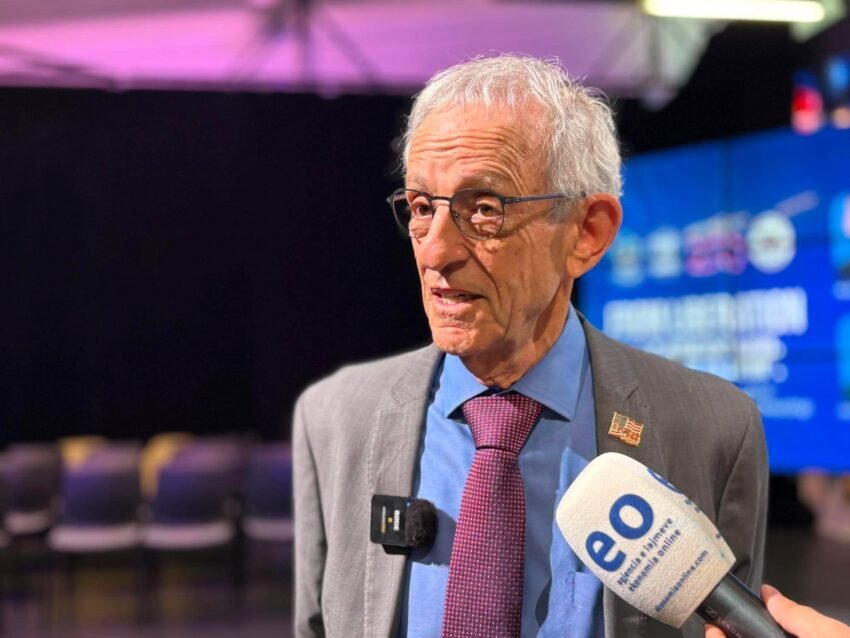
Daniel Serwer, a professor at Johns Hopkins University in Washington, has analysed Aleksandar Vučić’s loss of power in Serbia, the victory of the Students’ List and the challenges facing the country’s new parliamentary majority.
Serwer said Vučić “accepted defeat with dignity and without delay.”
The American professor argued that if the Students’ List maintains its unity, it will have a “considerable advantage” in parliament, with an estimated 135–140 seats in the 250-member National Assembly.
Presidential elections are scheduled for December 26 to replace Vučić, whose presidential term has ended and who had resigned in the hope of returning to power as prime minister, Serwer wrote on his website.
Serwer criticises Vučić’s foreign policy and domestic rule
According to Serwer, Vučić had initially presented himself as openly pro-European Union and played that role effectively until his election as president.
“After that, he increasingly turned to Moscow and Beijing for weapons and technology, while continuing to keep Washington and Brussels waiting with promises involving lithium and ammunition for Ukraine,” Serwer wrote.
He argued that Washington responded with what he described as excessive political support, while Brussels continued Serbia’s EU accession negotiations.
Serwer said Vučić had rearmed Serbia at considerable cost and sought to undermine Kosovo’s statehood while presenting himself as engaged in negotiations for what the EU called political normalisation.
Although Serbia’s foreign policy increasingly leaned towards Russia and China, Serwer argued, domestic governance became more authoritarian and corrupt. He accused Vučić’s government of bringing the media under state control, awarding contracts to political allies and failing to prosecute criminal groups operating openly.
Serwer said the EU had gradually become more aware of what he described as Vučić’s unreliability over the past year or so and had begun slowing Serbia’s accession process.
He also wrote that the US administration distanced itself from Vučić after a deal he had promised Jared Kushner failed to materialise. Members of the US Congress, Serwer added, had become increasingly vocal in criticising Serbia’s alignment with Russia and China.
Challenges facing the Students’ List
Serwer described the student movement’s evolution, saying its initial focus was opposition to violence, followed by environmental concerns and, more recently, the fight against corruption.
He praised the movement’s grassroots organisation against a powerful political system supported by nationalist credentials and extensive patronage networks.
According to Serwer, the Students’ List has outlined a concise programme focused on the rule of law, free media, meritocracy, education, employment, food, housing and healthcare.
Many of its parliamentary candidates are not nationally known figures. Serwer noted that student-led plenums selected the candidates following interviews, although the list itself does not include students. It is made up largely of professionals and is led by a cardiologist.
Serwer cautioned that the new parliamentary majority should not expect an easy transition.
“Vučić’s people, experienced in parliamentary procedures and political manoeuvring, will undoubtedly do everything they can to make their work difficult,” he wrote.
He added that the newly elected lawmakers would have to learn to organise themselves and establish internal discipline in ways they had not previously experienced. Choosing a president in December who could support their efforts would be vital, he argued.
Kosovo and Serbia’s European future
Serwer observed that the student movement had said relatively little about foreign policy, and that some of its limited statements had raised concerns.
He referred to the movement’s Kragujevac Memorandum, which reiterated Serbia’s claim to sovereignty over Kosovo. However, Serwer cited a Belgrade-based expert who suspected that the students might seek ways to soften, if not resolve, the dispute.
He also suggested that the new lawmakers would seek to accelerate Serbia’s EU accession process and repair relations with the United States.
Serwer did not expect Serbia to sever its ties with Russia and China entirely. He argued that Russia continued to exert influence over Serbia’s security apparatus, which he said would require a thorough vetting process, while China remained a major source of investment that Serbia would continue to need.
Nevertheless, he expressed hope for a gradual shift towards the West, at least reversing the eastward direction of foreign policy under Vučić.
Serwer draws parallels with US politics
In the final part of his commentary, Serwer referred to the strong support that supporters of the MAGA movement had reportedly shown for Vučić, drawing parallels with their support for Israeli Prime Minister Benjamin Netanyahu and former Brazilian president Jair Bolsonaro.
He argued that public frustration with dishonesty, racism, corruption, offensive rhetoric and the exploitation of poorer citizens was generating a political backlash.
“The pendulum is swinging,” Serwer wrote, concluding with the hope that it would swing far enough to produce what he called a “Blue Wave” in the United States.
Serwer’s assessment presents Serbia’s election result as both a domestic political transition and a potential turning point in the country’s relations with the EU, the United States, Russia and China. The extent of any foreign-policy shift will depend on the new majority’s cohesion, its decisions on Kosovo and its ability to establish effective control over state institutions.