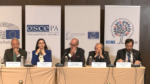
The defeat of Serbian President Aleksandar Vučić’s Serbian Progressive Party (SNS) in Serbia’s parliamentary elections could reshape the political representation of Serbs in Kosovo and create new opportunities for progress in the Kosovo-Serbia dialogue, according to experts from the International Crisis Group, Marko Prelec and Fabienne Hara.
Marko Prelec, the organisation’s senior analyst for the Western Balkans, described the student movement’s victory in the October 25 elections as a major political shift whose consequences are likely to be felt across the region, particularly in Kosovo.
The SNS, which had been in power for 14 years, exercised considerable influence over Serbian voters in Kosovo, Prelec said.
“The political earthquake in Serbia is high on the Richter scale. It marks the first electoral victory of a broad-based movement that resisted pressure to organise itself as a political party and deliberately avoided professional politicians among its ranks,” Prelec said.
He argued that the Students’ List represented a new approach to the challenges of governance, with potential implications not only for Serbia but also for Europe and beyond.
The immediate consequences, he said, could be particularly significant in Kosovo, where the SNS had maintained strong control over the Serbian minority electorate.
“Serbs in Kosovo will now be free to choose their preferred representatives without pressure from Belgrade,” Prelec said.
According to the analyst, Serbia’s new government could be more committed to protecting the rights of Serbs in Kosovo while maintaining a supportive relationship with Serbs in Bosnia and Herzegovina.
Fabienne Hara, director of the International Crisis Group’s Europe programme, described the election result as an extraordinary political change and evidence of the commitment of young people and civil society to strengthening the rule of law, fighting corruption and improving democracy.
Following Viktor Orbán’s defeat in Hungary earlier this year, Serbia’s election result could signal a renewed wave of democratic energy across Europe, Hara said.
She added that the political changes in Serbia could create opportunities for more constructive relations between Belgrade and the European Union.
“This change could create a rare opportunity to make progress towards resolving the long-standing and deeply divisive conflict between Serbia and Kosovo,” Hara said.
Students’ List wins amid calls for a review of Kosovo agreements
The parliamentary elections on October 25 ended 14 years of rule by the SNS, which faced accusations of corruption and authoritarianism during its time in power.
Vučić, who had called the early elections in an effort to return to the post of prime minister after leaving the presidency, blamed his political camp’s defeat on alleged interference by foreign actors. He referred to several European countries and what he called the “American deep state” opposing US President Donald Trump.
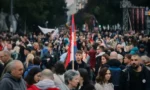
The Students’ List emerged from student-led anti-corruption protests launched after the collapse of a railway station canopy in Novi Sad in 2024, which killed 16 people.
The movement does not have a single leader. Students organise through plenums, where decisions are made collectively, and supported a slate of candidates from different professional and social backgrounds in the elections.
During the campaign, candidates on the Students’ List called for all agreements reached in the Kosovo-Serbia normalisation dialogue to be reviewed, for Kosovo’s status to be raised again at the United Nations, and for decisions concerning Kosovo to be made only after consultations with Kosovo Serbs.
The list maintains that “Kosovo is an integral part of Serbia, as stated in the country’s Constitution.”
Despite the possibility of a change in political representation, the Students’ List’s stated position indicates that its victory does not necessarily signal a shift towards recognising Kosovo’s independence.
Preliminary results show a parliamentary majority for the Students’ List
According to preliminary figures from Serbia’s Electoral Commission, the Students’ List received 52.54 per cent of the vote, based on results processed from 8,077 of the country’s 8,392 polling stations.
The United Serbia list, formed around the SNS, received 39.29 per cent, while the Socialist Party of Serbia (SPS), led by Ivica Dačić, won 2.18 per cent and failed to cross the electoral threshold.
With 96 per cent of the sample processed, CeSID projected that the Students’ List would secure 140 seats in Serbia’s parliament, compared with 103 for United Serbia. The Alliance of Vojvodina Hungarians was projected to win three seats, the Albanian Coalition two, and the Rasim Ljajić-led Ljudski list and the Party of Democratic Action of Sandžak one seat each.
Serbia’s Electoral Commission reported turnout of 68.78 per cent, equivalent to 4,211,957 voters, with invalid ballots accounting for 1.29 per cent.
Vučić acknowledged the defeat, saying that the Students’ List had won more parliamentary seats.
“It is clear that we lost these elections,” he said.
He nevertheless claimed that his political camp had won in Kosovo.
The Albanian parties in Serbia contested the elections together under the banner of the Albanian Coalition, seeking to secure at least two seats in parliament. Coalition leader Shaip Kamberi said the practice of deactivating registered addresses had affected the coalition’s chances of winning a third seat.
Kosovo Prime Minister Albin Kurti, President Justina Shiroka-Pula and other politicians had urged eligible Albanian voters in Serbia to participate in the elections and support the coalition.
The election outcome could now affect the relationship between Belgrade and Kosovo Serbs, as well as the wider Kosovo-Serbia dialogue. However, the Students’ List’s stated position on Kosovo suggests that any changes in policy will depend on the new government’s decisions and its approach to consultations with Kosovo Serbs.