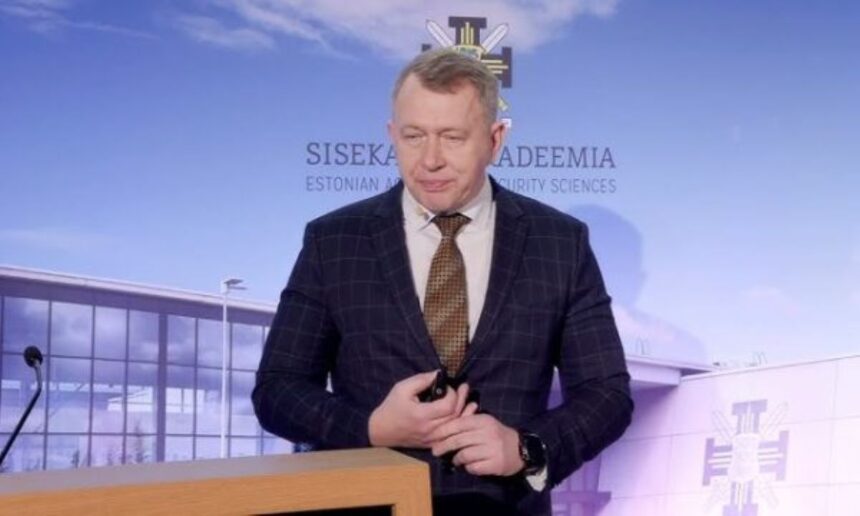
Russia remains the greatest threat to European security, and the continent must be prepared not only for potential military escalation but also for hybrid warfare, influence operations and long-term security challenges, according to Estonia’s Undersecretary for Internal Security, Joosep Kaasik.
In an interview with Radio Free Europe/Radio Liberty (RFE/RL), Kaasik said Estonia views deterrence as the most effective means of countering threats originating from Moscow.
Commenting on Russia’s recent live-fire military exercise on Lake Peipus near the Estonian border, conducted without prior notification, Kaasik said such activities are consistent with Russia’s established military behavior.
“We should view these developments calmly and in a balanced way because this is normal military activity. However, it is concerning for us because it means they are training to use force on Lake Peipus, which is not in our interest,” he said.
Kaasik argued that Russia frequently seeks to create uncertainty and fear among neighboring countries.
“They are not concerned about these issues and will do whatever they consider necessary. Part of their objective is achieved as soon as the entire world begins talking about these actions,” he said.
According to the Estonian official, Moscow does not view direct military escalation as its primary option, instead relying heavily on hybrid tactics to influence democratic societies.
“They prefer to influence our policies, shape ideas within our societies and use local populations to spread narratives that serve Russia’s interests,” Kaasik said.
Estonia is also leading efforts to prevent former Russian combatants from entering the Schengen Area.
Kaasik said Estonia has already imposed entry bans on approximately 3,100 individuals, arguing that former fighters pose a significant security risk to Europe.
“If you have fought against Ukrainians in this war, you should not have access to Europe. These individuals are easy targets for recruitment by Russian intelligence services and could be used for various attacks in the future,” he said.
He also reiterated his view that Russian tourists should not be granted visas while the war in Ukraine continues.
During the interview, Kaasik defended Estonia’s recently adopted legislation severing the administrative ties between the Estonian Orthodox Church and the Moscow Patriarchate.
He argued that no religious organization should maintain administrative links with a state or institution that supports war or terrorism.
“The Moscow Patriarchate has publicly supported this war of aggression. No democratic society should tolerate such a relationship,” Kaasik said.
He added that Russia’s full-scale invasion of Ukraine has demonstrated that national security depends not only on military capabilities but also on the resilience of society as a whole.
“The key is for the entire society to be prepared. The longer a society can withstand difficult conditions, the greater its chances of success,” he said.
Kaasik also called on the European Union to move more quickly in strengthening sanctions against Russia, arguing that countries farther from Russia’s borders often underestimate the scale of the security threat.
“We see this threat every day. Countries that are farther away from Russia often do not experience it in the same way,” he concluded.