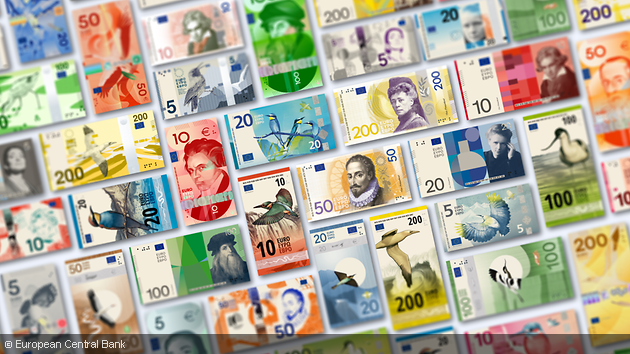
The euro is set to undergo its first major visual redesign since the common currency entered circulation in 2002, with the European Central Bank (ECB) unveiling the 10 finalist designs competing to become the next generation of euro banknotes.
The presentation marks the first opportunity for citizens across the eurozone to see what the future of the euro could look like, although the final design has yet to be selected.
ECB President Christine Lagarde announced that the shortlisted concepts will be presented publicly before being evaluated through a public consultation process alongside assessments by an independent panel of experts.
The redesign represents a significant shift in philosophy. The current euro banknotes feature fictional bridges, windows and gateways to avoid favoring the landmarks or symbols of any individual EU member state. The new series, however, aims to tell a story that reflects Europe’s shared identity.
In November 2023, the ECB’s Governing Council selected two overarching themes for the redesign: “European Culture: Shared Cultural Spaces” and “Rivers and Birds: Resilience in Diversity.” Decorative motifs for each denomination were finalized in January 2025 following an extensive consultation involving more than 365,000 European citizens and multidisciplinary expert groups from across the euro area.
“We are excited to present these motifs—images from real life that demonstrate our commitment to Europe and celebrate its cultural and natural heritage,” Lagarde previously said. “The new banknotes will symbolize our shared European identity and the diversity that makes us stronger.”
Under the cultural theme, each denomination would honor a prominent European historical figure alongside a landmark representing cultural life. The proposed €5 note features opera legend Maria Callas, while the €10 note honors composer Ludwig van Beethoven. Scientist Marie Curie appears on the €20 note, author Miguel de Cervantes on the €50, artist and inventor Leonardo da Vinci on the €100, and Nobel Peace Prize laureate Bertha von Suttner on the €200 banknote.
The alternative concept focuses on Europe’s natural environment, illustrating the journey of a river from its mountain source to the sea, accompanied by bird species representing different ecosystems. The reverse side of these banknotes would feature key European Union institutions, including the European Parliament, the European Commission, the ECB, the Court of Justice of the European Union, the European Council and the European Court of Auditors.
The unveiling of the finalist designs is only one stage of the process. Following public consultation, the ECB’s Governing Council is expected to select the winning design by the end of 2026. The chosen series will then move into detailed development, including the integration of advanced security features, before entering production and gradually replacing the current banknotes.
According to ECB Executive Board member Piero Cipollone, the redesign underscores the institution’s long-term commitment to physical cash while reinforcing the euro’s role as a symbol of European unity and shared values.