Kosovo could face a serious constitutional uncertainty in less than a month if a new president is not elected by October 4. Legal experts say that the Speaker of the Assembly cannot continue serving as acting president beyond this six-month deadline.
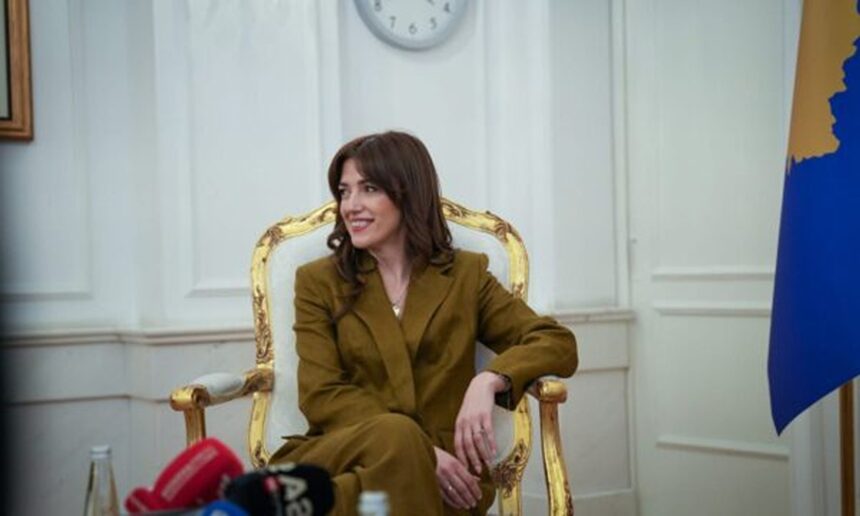
The current acting president, Albulena Haxhiu, was re-elected as Speaker of the Kosovo Assembly on September 9. Earlier, however, members of her party, the ruling Vetëvendosje Movement (LVV), had suggested that a newly elected Speaker could continue serving as acting president for another six-month period if necessary.
The Presidency which has been headed by Haxhiu since April 4, when former President Vjosa Osmani’s mandate ended has also stated that the newly elected Speaker would continue exercising the duties of president until a new president is elected.
Can Haxhiu continue serving beyond October 4?
No, according to several legal experts who spoke to Radio Free Europe.
Under Kosovo’s Constitution, the position of acting president cannot be exercised for longer than six months.
Vullnet Bugaqku of the Kosovo Democratic Institute (KDI) estimates that Haxhiu’s six-month mandate as acting president ends on October 4.
“After this date, the six-month period expires and legally, the same person no longer has the right to continue functioning as acting president, because this would be contrary to Article 90, paragraph 3, of the Constitution of Kosovo,” Bugaqku told Radio Free Europe on Wednesday, after Haxhiu was re-elected Speaker.
According to Bugaqku, any decision or decree that Haxhiu might issue after that date would be constitutionally contestable and could potentially be overturned by the courts.
He said lawmakers should view the October 4 deadline for electing a president as a matter of serious concern.
Haxhiu interrupted the constitutive session of the Assembly on Wednesday, postponing its continuation until Friday in order to complete the constitution of the Assembly.
She said there was no agreement on the voting procedure for deputy speakers and that Serbian List MP Igor Simić failed to withdraw the phrase “on behalf of the Serbian people” when proposing a candidate for deputy speaker from the Serbian community.
Meanwhile, Ehat Miftaraj, executive director of the Kosovo Law Institute, told Radio Free Europe that Kosovo’s Constitution links the six-month limitation to the exercise of the presidential office, rather than to the individual person exercising it.
According to Miftaraj, for this reason, changing the person serving as acting president — or re-electing the Speaker of the Assembly — cannot have the effect of starting a new six-month period.
“Such an interpretation would make it possible, simply by changing the person, to continue the exercise of the presidential office beyond the six-month limit expressly established by the Constitution,” he stressed.
“Going beyond October 4 without a new president undermines state security”
Bugaqku added that, for the state and Kosovo’s parliamentary constitutional system, going beyond the October 4 deadline would represent “a very serious stain and a dangerous precedent that also undermines national security.”
The six-month period during which, under the Constitution, Kosovo’s presidency may be held by an acting president ends on October 4.
LVV MP Adnan Rrustemi had previously told Radio Free Europe that the position of acting president “depends on the position of the Speaker of the Assembly.”
According to him, once elected, the new Speaker begins exercising the duties of president until a president is elected. He argued that the six-month period established by the Constitution would begin again with the election of a new Speaker.
“It is in the spirit and content, as well as the function, of the Constitution to guarantee institutional continuity. At no time and for no reason can the country be left without a president or an acting president. There can be no institutional vacuum under any circumstances,” Rrustemi told Radio Free Europe.
Earlier, Eugen Cakolli, a researcher at the Kosovo Democratic Institute, told Radio Free Europe that the six-month period for exercising the duties of president constitutes an absolute deadline and, as such, cannot be repeated under any scenario.
According to Cakolli, failure to elect a new president by October 4 would create the most dangerous constitutional scenario Kosovo could face.
“In such a situation, the country would enter constitutional territory which, besides being serious and dangerous, would necessarily have to be brought before the Constitutional Court,” he emphasized.
Melos Kolshi, a legal researcher at the Kosovo Law Institute, told Radio Free Europe that after October 4, any continuation of the acting presidency would have no constitutional basis and would seriously undermine the constitutional order.
Albanian opposition parties have not publicly commented on the issue.
The Democratic Party of Kosovo (PDK), Democratic League of Kosovo (LDK) and the Alliance did not respond to Radio Free Europe’s questions regarding the matter.
The election of the president has been at the heart of the country’s political crisis and triggered new parliamentary elections in June.
A fragile agreement between LVV and LDK over the candidacy of Kosovo diplomat and legal scholar Bekim Sejdiu does not appear to have the necessary support, as even some LDK lawmakers have publicly opposed it.