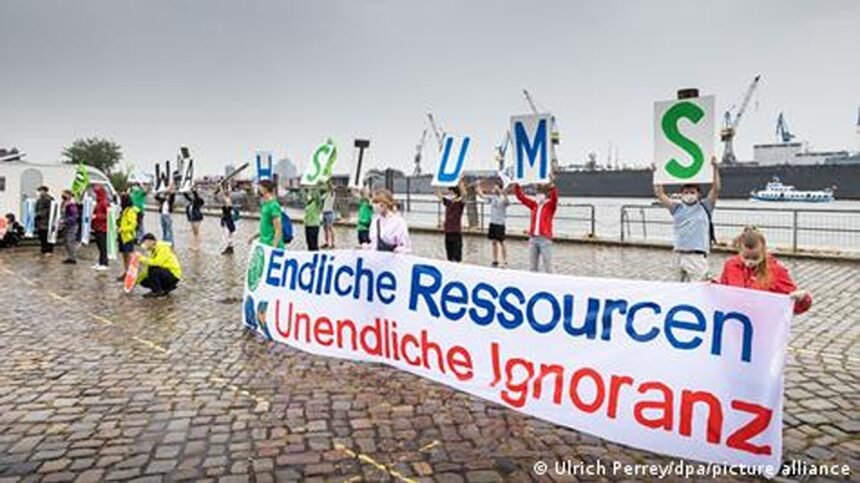
Germany has theoretically already consumed its natural resources for the year 2026. Environmental organizations criticize that Germany continues to use large amounts of oil, gas, and coal.
In theoretical terms, Germany reached its “Earth Overshoot Day” on Sunday (10 May), meaning it has used up the natural resources that should last the entire year. Within the framework of so-called Earth Overshoot Day, the Global Footprint Network calculates each year for individual countries and for the entire planet the date when the annually available natural resources have been consumed.
If all people in the world consumed as many natural resources and emitted as much CO₂ as the population of Germany, the Earth’s annual biological capacity would already have been exhausted in the first third of the year.
According to the NGO German Federation for the Environment and Nature Conservation (BUND), Germany consumes far more resources than it should, mainly due to the high use of fossil fuels. Among the main contributing factors are energy-intensive industries, the construction sector, road transport, and intensive livestock farming.
The consequences of this development are already clearly visible, such as droughts, extreme rainfall, and rising urban temperatures.
“Our current lifestyle and economy are not sustainable”
“Our current lifestyle and economic model is not sustainable for the future,” said BUND chairman Olaf Bandt. “Instead of switching to renewable energy, we continue to rely on coal, oil, and gas.”
According to him, solar and wind energy, heat pumps, and light, small, and efficient electric vehicles create independence, planning security, and protect the climate.
In 2025, Germany’s Earth Overshoot Day fell on May 3. The fact that this year’s date has been pushed back by one week is not the result of a more environmentally friendly lifestyle, but mainly due to updated data and changes in calculation methodology.