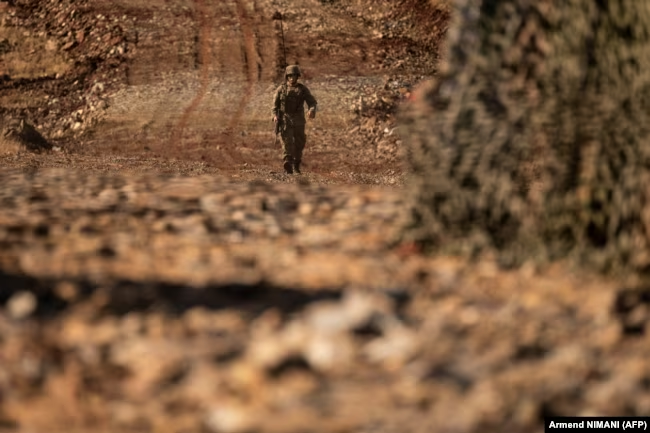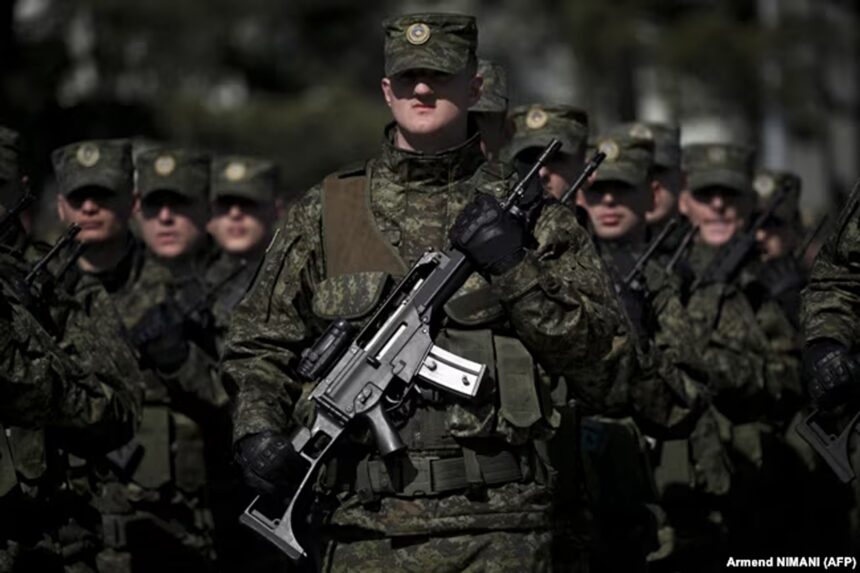
While the Kosovo Security Force (KSF) is approaching the final phase of its transformation into a fully fledged army, a key gap remains: the absence of a military hospital.
Two years before the completion of this process, KSF members are still forced to seek treatment outside military structures for more serious medical cases.
“When we need more advanced treatment, we go to public or private hospitals,” a KSF member told Radio Free Europe under condition of anonymity.
He explained that first aid and basic services are provided inside military barracks, while the Medical Center at the “Adem Jashari” Barracks in Pristina remains the most advanced medical facility within the force.
However, for more serious cases, options remain limited.
“The lack of a military hospital is a topic often discussed among us, especially for long-term or more severe cases,” he added.
Growing capabilities, lagging infrastructure
The transformation of the KSF into an army, which began in 2018, foresees that by 2028 the force will reach over 7,500 members, including 5,000 active troops a target that, according to the Ministry of Defense, has already been achieved.
This transformation includes not only an increase in troop numbers but also the development of new operational capabilities such as armament, training, and participation in international missions.
However, while military capacities are expanding, supporting infrastructure does not appear to be keeping pace.
The acting Minister of Defense, Ejup Maqedonci, briefly stated for Radio Free Europe that the KSF is developing its medical capacities based on the model of the U.S. military medical system, but did not provide further details.
“The KSF has a medical center that provides primary healthcare services and some specialist services,” he said, adding that the center also includes infrastructure for hospitalization.
Experts say a military hospital is essential
Former KSF Commander Kadri Kastrati said that building a military hospital at this stage of development is a necessity.
“The state must advance medical services, as regional and European countries have done,” he said.
According to him, the Medical Center at the “Adem Jashari” Barracks was originally designed to eventually become a military hospital.
Basic infrastructure exists, but investment in personnel and equipment is missing.
“This can be achieved if there is political will,” Kastrati added.
Security expert Ismet Ibishi, also a former Deputy Minister of Internal Affairs, stated that a military hospital is a standard feature of a modern army.
According to him, the presence of medical personnel in military operations is essential not only for treatment but also for troop safety and morale.
“Even during exercises soldiers can be injured, and even more so in combat zones,” he said.
Existing capacity and technical challenges
According to former director of the KSF Medical Center, Shkëlzen Sylaj, the facility inside the “Adem Jashari” Barracks has capacity for around 60 beds, but remains under-equipped and understaffed.
He highlighted the need for equipment such as MRI machines, CT scanners, and advanced laboratories, as well as 24-hour staffing.
“A hospital system means 24-hour service, and that requires several specialists for each profile,” Sylaj said.
He added that Kosovo has sufficient medical professionals including orthopedists, internists, cardiologists, and ophthalmologists but operationalizing a military hospital requires high costs and a new organizational structure.
Promises without deadlines and lack of transparency
The establishment of such an institution has also been mentioned at the highest state level.
In December 2023, then-President Vjosa Osmani stated that the project is part of a state program foreseeing tertiary-level healthcare services for military personnel, police, and their families.
However, institutions have not provided concrete details regarding timelines or implementation stages.
Meanwhile, the 2023 Defense Strategy does not mention the project at all.
Radio Free Europe requested clarification from the Office of the President, the Prime Minister’s Office, the Ministry of Defense, and the KSF, but received no response.
The KSF also refused a request to visit the Medical Center at the “Adem Jashari” Barracks, citing scheduled engagements.
The Ministry of Health also did not respond regarding potential support capacity.
According to the Ministry of Defense’s 2024 annual report, in cases requiring specialized treatment abroad, the KSF cooperates with the GATA medical institution in Ankara, Türkiye.
Growing need with international missions
The need for advanced medical capacities has become even more urgent with KSF participation in international missions.
Recently, several KSF members were deployed on a stabilization mission in Gaza under a United Nations mandate.
A verification team was sent in late April, but it has not been confirmed whether medical personnel were included — raising further concerns about field support.
Experts emphasize that medical teams in military operations significantly improve troop safety and confidence. Regional comparison
Unlike Kosovo, countries in the region have developed fully functional military medical systems.
In Albania, the University Military Hospital has been operating since 1993, serving both military personnel and civilians.
Serbia operates one of the largest military hospitals in the region with extensive infrastructure.
North Macedonia also maintains a Military Medical Center integrated with the public health system.
Under NATO doctrine which Kosovo aspires to join military medical support is structured in multiple levels, from battlefield first aid to advanced hospital care.