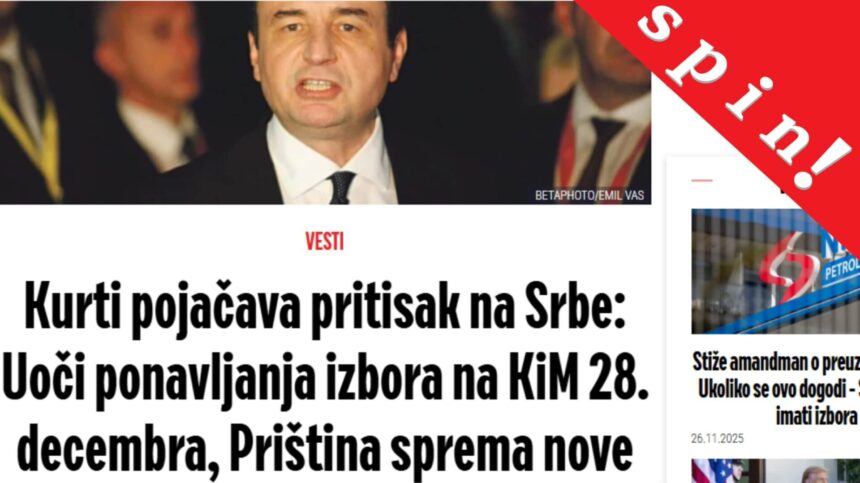
Serbian pro-government tabloids, led by Večernje Novosti and followed by portals such as Informer and Alo, published a story on Tuesday evening under the headline: “Kurti Increases Pressure on Serbs: Prishtina Preparing New Provocations…”
The headline suggests a verified fact established by journalists. However, the claim is based solely on the opinion of one commentator, not on evidence, documents, or official statements.
A Headline Suggesting Facts — A Text Based on Opinions
The article, published ahead of Kosovo’s fourth round of elections this year—early parliamentary elections set for 28 December—focuses on allegations that the government in Prishtina routinely “steps up pressure on Kosovo Serbs” during campaigns. These claims are attributed to unnamed “sources” and later to historian and analyst Srđan Graovac.
The piece argues that holding elections during the holiday season supposedly benefits Kosovo’s Prime Minister Albin Kurti, allowing “manipulation of the electoral process” to go unnoticed by EU institutions. This, again, is presented without supporting evidence.
While Novosti cites the EU’s statement expressing regret over Kosovo’s prolonged political crisis, the outlet criticizes Brussels for not attacking Kurti more directly—reflecting a familiar narrative within Serbia’s pro-Vučić media landscape, which routinely frames Kosovo politics in highly antagonistic terms.
The article also repeats long-standing claims from Belgrade’s ruling circles regarding supposed “electoral engineering” and “illegal appointments,” attempting to portray Kurti’s government as illegitimate.
Opinion Disguised as Reporting
Midway through the article, Novosti finally reveals the source of the central claim: historian Srđan Graovac, who asserts that Kurti can be expected to launch “new provocations” because he “always intensifies pressure on Serbs during campaigns.” Graovac also speculates that the election date was chosen to attract votes from diaspora Albanians returning for the holidays.
These are subjective assessments, not facts. Yet the headline presents them as an established reality.
Why This Is Misleading
The assertion that Prishtina is “preparing new provocations” is not supported by evidence. It is not backed by documents, official statements, or verified events. The headline fails to indicate that it reflects only a commentator’s opinion—misleading readers into believing the newspaper has proof.
Professional journalism requires clarity when headlines reflect opinions, for example:
“Analyst Claims…”, or “Experts Warn of Possible…”
Novosti did not apply this standard.
Amplified by the Pro-Vučić Media Network
The situation is worsened by the fact that the same misleading headline was copied and redistributed by major Belgrade tabloids known for echoing the narrative of the Vučić regime—Informer, Alo, and Srbija Info.
Without fact-checking or contextual analysis, these outlets multiplied the sensationalistic message, contributing to a climate of fear and political manipulation.
Sensation Over Substance
The article also uses highly charged language—“tightening the noose,” “violence from Prishtina,” “gross electoral engineering,” “installing Rašić”—all hallmarks of sensationalism. This style is typical of media aligned with the ruling Serbian Progressive Party (SNS), which often employ fear-based narratives to influence public opinion on Kosovo.
Conclusion
The Novosti report exemplifies a systemic problem in Serbia’s pro-government press, where opinion is routinely presented as fact, narratives are politically aligned with the Vučić administration, and sensationalism replaces responsible journalism.
In this case, a misleading headline, an opinion presented as fact, and replicated propaganda across multiple outlets collectively misinformed the public—once again amplifying a narrative rather than informing citizens.