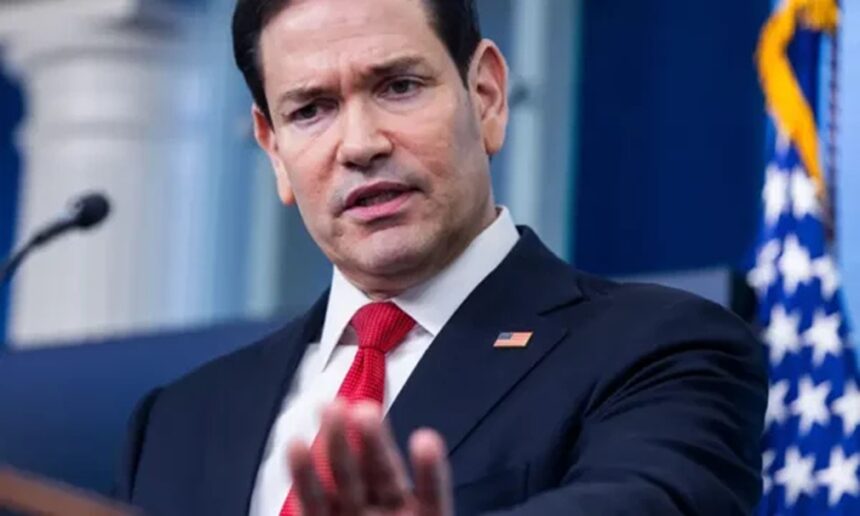
U.S. Secretary of State Marco Rubio issued a stern warning to Iran on Wednesday as tensions between Washington and Tehran escalated following Iranian claims of missile and drone strikes against U.S. military facilities in Kuwait.
Speaking on the sidelines of the Association of Southeast Asian Nations (ASEAN) meetings in Manila, Rubio responded to recent threats from Tehran after Iranian Foreign Minister Abbas Araghchi pledged an “eye for an eye” response to President Donald Trump’s warning that the United States would bomb Iranian infrastructure if attacks on shipping in the Strait of Hormuz continued.
“The president’s policy is an eye for an eye,” Rubio told reporters. “They will pay a very heavy price for what they are doing. In fact, they are already paying a very heavy price.”
The exchange came as the conflict expanded across multiple fronts overnight.
Iran’s Islamic Revolutionary Guard Corps (IRGC) and the Iranian military claimed they had launched strikes against several U.S. military installations in Kuwait in retaliation for renewed American attacks on Iranian targets. Iranian state media reported that the alleged targets included Ali Al Salem Air Base, Camp Doha, Camp Arifjan, Camp Udairi, and a telecommunications facility.
Kuwait’s military said it intercepted multiple drone threats following the attacks, while Jordan’s armed forces announced they had shot down three missiles and another projectile that landed in an uninhabited area without causing damage.
Meanwhile, the conflict spread into the Red Sea after Saudi state media reported that a Saudi-flagged vessel had come under attack. Yemen’s Iran-backed Houthi rebels claimed responsibility for missile and drone strikes targeting two Saudi oil tankers, Encelia and Layla. The group has also threatened to block Saudi ports in the Red Sea and disrupt shipping through the Bab al-Mandab Strait.
President Trump signaled that Washington would respond forcefully to any attempt to blockade Saudi shipping routes. Speaking at the White House on Tuesday, he said the United States would “take care of it” if such a scenario materialized, referring to previous large-scale U.S. air campaigns against Houthi positions in Yemen.
In the Strait of Hormuz, the IRGC claimed it had turned back three oil tankers and warned that any vessel transiting the waterway without coordinating with Tehran would face similar consequences. The statement directly challenged Trump’s warning that the United States would strike Iranian infrastructure each time Tehran targeted commercial shipping in the strategic waterway.
The latest escalation followed a twelfth consecutive night of U.S. strikes on Iranian military infrastructure. U.S. Central Command (CENTCOM) said its overnight operations targeted Iran’s naval capabilities, missile and drone depots, coastal surveillance positions, and air defense systems to further reduce Tehran’s ability to threaten international maritime traffic.
Iranian state media reported that the strikes killed two people near the Iraqi border and also hit the city of Bushehr, home to Iran’s only civilian nuclear power plant.
The conflict has continued to grow more costly for both sides. U.S. Defense Secretary Pete Hegseth recently estimated that military operations have cost the United States $37.5 billion, up from an estimated $29 billion in May.
President Trump said this week that he does not believe Iran is currently ready for a negotiated settlement, arguing that Tehran repeatedly seeks to renegotiate agreements after reaching them. “They’re not ready. They will be very soon,” he said.
A temporary ceasefire reached in mid-June has effectively collapsed after fighting resumed this month over security in the Strait of Hormuz. According to reports, the United States has deployed additional troops, medical teams, and military equipment to the region.
Jordan also confirmed overnight that it intercepted four missiles and four drones, while Bahrain activated air raid sirens amid the escalating regional conflict.
Rubio also declined to comment on reports suggesting Russia may be assisting Iran in targeting U.S. forces following his meeting with Russian Foreign Minister Sergei Lavrov in Manila. While refusing to discuss intelligence matters publicly, Rubio said Iran has spent years independently developing its missile and drone capabilities and suggested outside assistance has not significantly altered Tehran’s ability to target American forces.