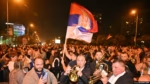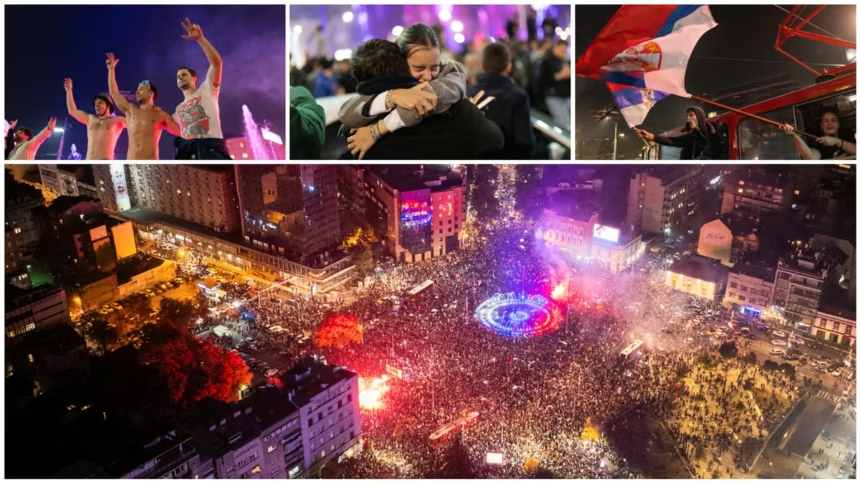
Serbia is facing a major political turning point after the Students’ List – Students Are Winning emerged victorious in Sunday’s parliamentary elections, following nearly two years of mass student-led and citizen protests. Former Serbian President Aleksandar Vučić acknowledged the defeat of his political camp, while celebrations took place across the country and continued late into the night.
According to preliminary estimates by the Center for Free Elections and Democracy (CeSID), voter turnout nationwide reached 69.3%.
Based on its final projection after processing 96% of the sample, CeSID estimated that the Students’ List would secure 140 seats in Serbia’s 250-member National Assembly.
The United Serbia list is projected to win 103 seats, while the Alliance of Vojvodina Hungarians would receive three seats. The Albanian Coalition would secure two seats, while the lists led by Rasim Ljajić and the Sandžak Democratic Party of Action (SDA Sandžak) would each win one seat.
The Socialist Party of Serbia, European Serbia and Authentic Right failed to cross the electoral threshold, along with nine other lists out of the 18 that contested the election.
The Republic Electoral Commission (RIK) has begun counting votes cast by Serbian citizens abroad. Preliminary results from four of the 93 polling stations abroad showed the Students’ List receiving 4,882 votes, or 88.72%, compared with 435 votes, or 7.9%, for the list aligned with the Serbian Progressive Party (SNS).
The Students’ List is also projected to have won in all 17 municipalities of Belgrade, marking a significant setback for the SNS in the capital.
Celebrations and calls for change
Students in the blockade movement have called for another gathering at Belgrade’s Slavija Square at 7 p.m., inviting supporters to continue celebrating the result.
The elections also prompted reactions from public figures and business representatives. Serbian business association Privrednik congratulated the Students’ List, expressing hope that the next period would prioritise economic stability, support for domestic businesses, investment and a favourable environment for entrepreneurship.
Basketball coach Željko Obradović also welcomed the outcome, saying he was happy that elections had taken place in Serbia and that a large number of citizens had participated. He said the turnout showed that people understood the situation facing the country and wished young people who had achieved the victory all the best.
Meanwhile, Serbian military analyst Aleksandar Radić warned that the incoming political leadership should move quickly to establish effective oversight of the security services. He raised concerns that documents potentially relevant to criminal proceedings against members of the outgoing authorities could be destroyed.
Radić said the priority should not be retaliation or a political purge, but the professionalisation of state institutions and the removal of officials who, he alleged, had used the security apparatus for political purposes.
Regional implications
North Macedonian political analyst Petar Arsovski described Vučić’s prompt acceptance of defeat as a positive signal, arguing that it increased the likelihood of a peaceful transfer of power.
Speaking to the newspaper Sloboden Pečat, Arsovski said a victory for the Students’ List could accelerate Serbia’s path towards European Union membership and bring its foreign policy closer to the EU’s position, potentially including sanctions against Russia.
He added that faster progress by Serbia towards EU integration could increase pressure on North Macedonia, particularly as Montenegro and Albania advance in their own accession processes.
Arsovski also said it remained to be seen whether Serbia’s student movement would inspire young people in North Macedonia. He stressed that the Serbian students had distanced themselves from established political parties and focused their demands on changing the political system rather than simply replacing individual politicians.
He pointed to student protests planned across Europe for November 29 as a possible indication of whether the movement would gain traction beyond Serbia.
What happens next?
Under Serbia’s electoral procedures, the newly elected National Assembly must be constituted within 30 days of the official proclamation of the final election results.
The Republic Electoral Commission must prepare its overall report within 96 hours of receiving all consolidated reports from local electoral commissions, although objections to the results may affect the timeline. Parliamentary mandates are then allocated in accordance with the electoral lists and confirmed at the Assembly’s first session.
Once the Assembly is constituted, a 90-day period begins for the formation of a new government. The President of Serbia proposes a candidate for prime minister after consulting representatives of the elected lists. The nominee must present a government programme and proposed cabinet to parliament, which votes on both.
A government is elected if it receives the support of a majority of all members of the National Assembly.
The election period was also marked by concerns about press freedom. The Association of Journalists of Serbia reported physical attacks on journalists, restrictions on reporting from polling stations and local electoral commissions, website disruptions, and refusals of entry into Serbia for journalists from Croatia and North Macedonia.
With the Students’ List projected to command a substantial parliamentary majority, attention is now turning to the final certified results, the constitution of the new Assembly and the formation of a government following a prolonged period of political unrest.