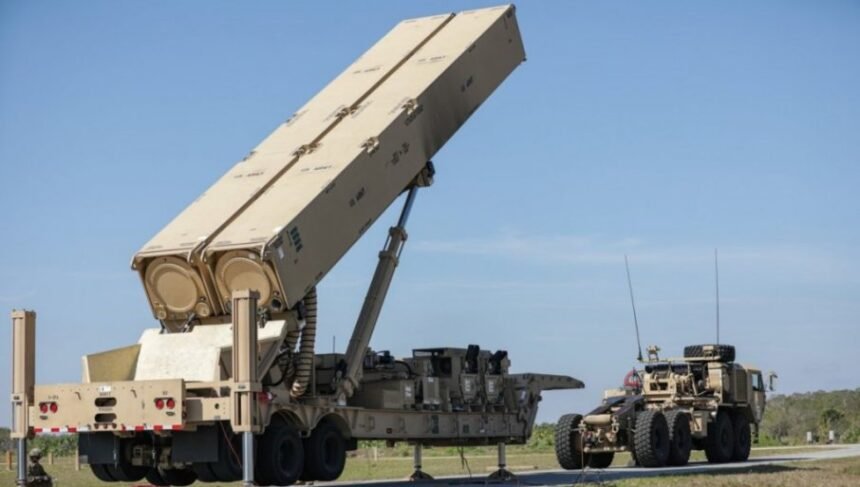
The United States has carried out the first operational deployment of its Dark Eagle long-range hypersonic missile system in the Western Pacific, marking a significant milestone in Washington’s efforts to strengthen its military posture in the Indo-Pacific amid growing competition with China.
While the Pentagon has not disclosed the exact location of the deployment, military exercises involving the system were conducted across Guam, the Northern Mariana Islands, Palau and surrounding areas in the Western Pacific. From these locations, the missile system could potentially place parts of China’s eastern coastline within range.
Dark Eagle is designed to strike heavily defended and time-sensitive targets, including command-and-control centers, integrated air defense systems, missile launch sites, naval facilities and critical logistics hubs.
Pentagon’s Advanced Hypersonic Weapon
Unlike conventional ballistic missiles, Dark Eagle uses a hypersonic glide vehicle that accelerates to speeds exceeding Mach 5 before maneuvering unpredictably toward its target.
The combination of extreme speed and maneuverability significantly complicates interception by existing missile defense systems while reducing warning times for defenders.
The system has experienced years of technical challenges, testing delays and rising development costs. After a successful flight test in late 2024, additional testing continued throughout 2025 and 2026 before the U.S. Army declared the system to have achieved limited operational capability. Production, however, remains limited, with only a small number of launchers and missiles currently available.
China Maintains a Hypersonic Lead
Despite the deployment, analysts note that China continues to hold an advantage in operational hypersonic weapons.
Beijing began deploying its DF-17 hypersonic missile system in 2019, several years before the United States fielded Dark Eagle. The DF-17 is believed to be deployed across multiple People’s Liberation Army missile brigades and has become a central component of China’s regional strike capabilities.
China is also reportedly developing longer-range systems, including the DF-27, while continuing work on hypersonic anti-ship weapons and expanding hypersonic capabilities across land, sea and potentially air platforms.
Strategic Balance in the Indo-Pacific
Although China has made faster progress in hypersonic missile development, the United States retains a strategic advantage through its extensive network of overseas military bases.
Forward deployment of systems such as Dark Eagle allows the U.S. to position long-range strike capabilities much closer to potential areas of conflict in the Indo-Pacific. By contrast, China lacks a comparable global basing network and must rely more heavily on long-range strategic systems to threaten targets on the U.S. mainland.
The deployment highlights the intensifying military competition between Washington and Beijing as both powers continue investing heavily in next-generation missile technologies and long-range precision strike capabilities.