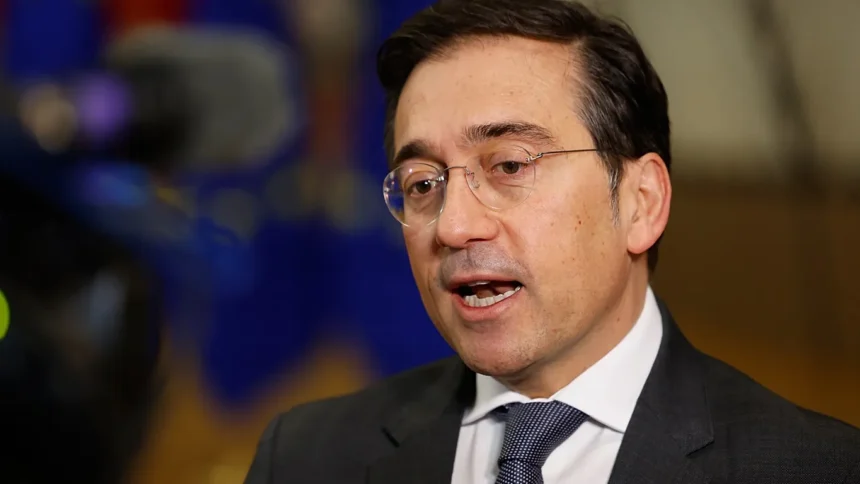
Spanish Foreign Minister José Manuel Albares Bueno has stated that securing passage through the Strait of Hormuz is outside NATO’s remit, pushing back against calls from US President Donald Trump for the alliance to take action amid growing tensions over freedom of navigation in the strategic waterway.
Speaking in the Spanish Senate on Friday, Albares said NATO “has no involvement in this war” and stressed that member states had not been consulted on any potential mission.
“The Middle East is not within NATO’s sphere of action, and therefore, NATO will not participate in this war,” he said, adding that many allies share the same position.
Spain has taken a critical stance toward recent US military actions involving Iran, which Madrid has described as violations of international law. The Spanish government has also previously restricted its airspace for certain US-linked military operations.
Despite its objections, Spain joined a joint statement earlier this week committing to support efforts aimed at ensuring freedom of navigation through the Strait of Hormuz, a vital global shipping route connecting the Persian Gulf with the Indian Ocean.
NATO Secretary General Mark Rutte has been attempting to build consensus among allies for a coordinated mission to secure maritime traffic in the region. However, any NATO deployment would require unanimous approval from all 32 member states, making agreement difficult due to opposition from several countries.
The debate comes as tensions escalate between Washington and European allies over the scope of NATO’s global role. Trump has repeatedly criticized NATO members for not contributing military assets to secure the Strait of Hormuz and has threatened to reconsider US commitments to the alliance.
At the same time, the strategic waterway remains heavily disrupted, with reports of shipping delays and security risks affecting global supply chains.
While some European states, including Germany, have expressed conditional support for an internationally mandated mission, efforts to secure a United Nations Security Council resolution have been blocked by vetoes from China and Russia.
Meanwhile, the United Kingdom is reportedly leading a broader “coalition of the willing,” involving more than 40 countries, aimed at restoring safe passage through the strait outside NATO structures.