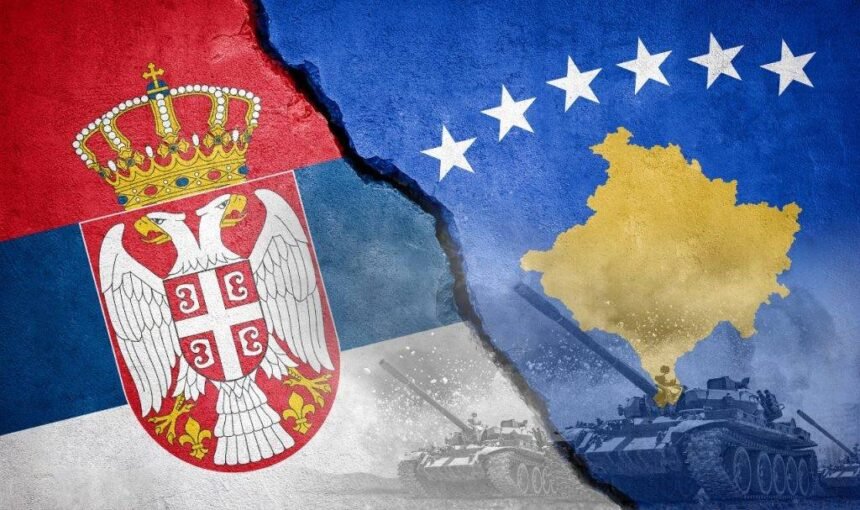
Marko Đurić, Serbia’s Foreign Minister, recently told the United Nations Security Council that Kosovo’s defense development is altering the regional “security balance.” The phrase, carefully chosen, reflects a long-standing diplomatic strategy in Belgrade: framing Kosovo’s institutional military development as destabilizing, while avoiding explicit acknowledgment of Kosovo’s armed forces.
Yet a closer examination of military capacities, defense doctrines, and procurement trends across the region suggests a different reality. The issue is not a sudden shift in balance, but rather the gradual erosion of Serbia’s historical ability to operate with uncontested strategic advantage in relation to Kosovo.
A rhetorical concept: “security balance”
The term “security balance” is inherently elastic. Unlike measurable military parity, it allows political actors to describe asymmetry in subjective terms. This flexibility enables alarmist framing even when quantitative disparities remain substantial.
In Serbia’s case, the concept serves a dual function. First, it highlights Kosovo’s defense modernization as a potential destabilizing factor. Second, it avoids directly acknowledging Kosovo’s evolving security institutions as a military force—an implicit recognition that would carry political implications regarding statehood.
Serbia’s military dominance remains intact
From a strictly military standpoint, Serbia continues to maintain a significant advantage in the Western Balkans.
Its defense expenditure exceeds €2 billion annually, placing it far ahead of regional counterparts. Serbia has expanded its arsenal with advanced systems including supersonic air-to-surface missiles, modern air defense platforms, and a growing fleet of multirole combat aircraft. Strategic procurement agreements with international defense suppliers further enhance its command, control, and intelligence capabilities.
Taken together, these developments reinforce Serbia’s position as the dominant conventional military power in the region.
However, this dominance does not exist in a political vacuum. Its significance lies not only in capability, but in how it has historically shaped regional dynamics—particularly in relation to Kosovo.
Kosovo’s defense model: deterrence rather than projection
Kosovo’s military development follows a fundamentally different logic. With a defense budget measured in hundreds of millions rather than billions, its forces are structured around denial rather than projection.
Procurement priorities—including anti-tank missile systems, tactical drones, and light armored mobility platforms—reflect a defensive doctrine aimed at increasing the cost of any potential incursion. Rather than seeking parity with Serbia, Kosovo is building a force designed to deter by complicating operational assumptions.
Additionally, Kosovo’s increasing participation in NATO-aligned training exercises and international deployments indicates a broader institutional trajectory toward interoperability with Western defense structures.
While modest in scale, these developments represent a qualitative shift: the emergence of an organized, structured defense institution integrated into Euro-Atlantic frameworks.
The erosion of strategic asymmetry
The central argument advanced in Đurić’s UN framing is that Kosovo’s defense development is destabilizing. However, the underlying structural change is not a reversal of military superiority.
Instead, what is being altered is Serbia’s historical ability to treat military dominance as a low-cost political instrument.
For much of the post-1999 period, the disparity in force capabilities allowed Belgrade to maintain a form of strategic leverage over Kosovo without direct confrontation. That leverage functioned primarily through asymmetry: the certainty that Kosovo lacked sufficient capacity to impose meaningful costs in the event of escalation.
Kosovo’s evolving defense posture does not eliminate Serbia’s superiority. Rather, it introduces a deterrent layer that raises the potential cost of coercive scenarios, thereby narrowing the space in which military asymmetry translates into political leverage.
Recognition and political constraints
A key dimension of Serbia’s position is linguistic and diplomatic rather than purely military. Referring explicitly to Kosovo’s armed forces would imply acknowledgment of Kosovo as a sovereign security actor. This remains politically unacceptable for Belgrade, which continues to contest Kosovo’s independence.
As a result, official discourse tends to describe outcomes without naming the underlying institution responsible for them. Kosovo’s military development is discussed as a “factor” affecting stability rather than as the expansion of a defense force.
This rhetorical choice reveals the underlying tension: the challenge is not only military, but also symbolic and legal.
Transparency and competing narratives
Serbian officials have also raised concerns about transparency in Kosovo’s defense development. However, similar scrutiny can be applied to Serbia’s own procurement processes, which often lack granular public oversight in terms of disaggregated budget reporting and full disclosure of strategic acquisitions.
This mutual lack of transparency contributes to competing narratives rather than shared strategic understanding. In such an environment, security discourse becomes increasingly interpretive, shaped as much by political objectives as by verifiable data.
Conclusion: from imbalance to normalization
The Western Balkans is not experiencing a sudden collapse of military equilibrium. Instead, it is undergoing a slow transition from absolute asymmetry toward limited mutual deterrence.
Serbia retains overwhelming conventional superiority in terms of scale, technology, and budget. Kosovo, however, is progressively building a defensive architecture designed to ensure that this superiority cannot be translated into unopposed political pressure.
In this sense, the “security imbalance” described in diplomatic forums is less an objective condition and more a reflection of shifting expectations: from uncontested dominance to constrained interaction.
The change is not in the existence of military disparity, but in its consequences.