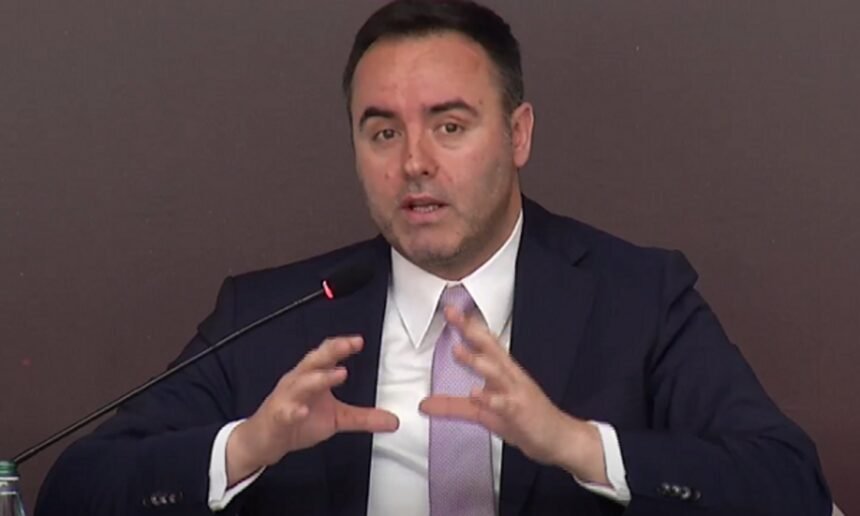
The Minister of Foreign Affairs and Diaspora of Kosovo, Glauk Konjufca, is participating in the fourth Diaspora Summit being held in Tirana, in a panel alongside his Albanian counterpart Ferit Hoxha, the leader of BDI Ali Ahmeti, Albanian MP in Montenegro Dritan Abazović, and others.
During the summit, Konjufca presented several ideas on how to strengthen ties between the diaspora and the homeland, stating that the “folkloric phase” has already been surpassed.
One of the first steps, according to him, should be the deployment of teachers to five countries with the largest Albanian diaspora: the United States, Greece, Italy, Germany, and Switzerland.
Konjufca emphasized that the focus should be on nurturing the Albanian identity of children:
“If we could reach these countries and send a large number of teachers, financially supported by the Republic of Albania and the Republic of Kosovo, they would help maintain Albanian-language education in cities where our diaspora is most concentrated.”
He noted that, so far, such efforts have largely been organized voluntarily by diaspora communities.
According to Konjufca, the number of diaspora children attending Albanian-language schools remains very low—likely not even reaching 10%.
“It is often more a matter of family effort—how much parents nurture their children with Albanian identity, language, history, and storytelling. But this should not remain solely within the family. The current level of participation is not satisfactory, and we need to elevate it,” he said.
Another key priority, he added, is building stronger networks within the diaspora, describing it as a “very important project.”
“We need to create unified umbrella structures for all Albanian organizations and associations,” Konjufca stated, acknowledging their contributions so far.
He further emphasized the need for what he called a “positive politicization” of the diaspora—not in a party-political sense, but in strengthening their connection with their home countries.
“This kind of positive, state-oriented engagement is what we need. We must organize and connect our diaspora more effectively,” he concluded.