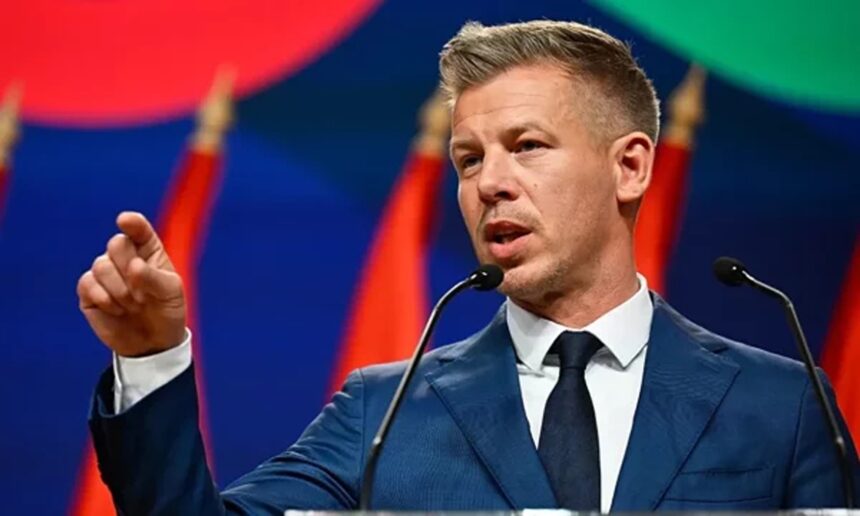
The election of Péter Magyar as Hungary’s future prime minister — ending 16 years of Viktor Orbán’s rule could reshape Orbán’s influence network in Brussels, from EU Commissioner Olivér Várhelyi to MCC Brussels, a think tank linked to the government.
His Tisza Party, which secured a two-thirds constitutional majority, has pledged to reorient Hungary’s relations with the EU and NATO. Although Magyar has not yet detailed his plans for Brussels, he promised radical changes during the campaign and after the vote.
“A simple change of government is not enough to solve these problems; a regime change is needed, because an organised criminal group is effectively running our country,” Magyar said on Monday at an international press conference.
Magyar also called on key state figures, including President Tamás Sulyok, to resign or face dismissal.
He also targeted some of Orbán’s closest allies, part of a wealthy inner circle, such as Hungary’s richest man, Lőrinc Mészáros.
In recent years, Orbán has built an extensive network in Brussels to advance and reinforce his political agenda. Several key figures now face possible removal, while allied organisations may see reduced funding.
EU Commissioner Várhelyi as the weakest link
One of Orbán’s most prominent allies in Brussels is Olivér Várhelyi, the EU Commissioner for Health and Animal Welfare.
Neither Hungary nor the Tisza Party has explicitly named him as a target, but many in Brussels see a change of government as an opportunity to push for his removal.
Várhelyi is considered a close ally of Orbán and has regularly attended political events organised by the Patriots for Europe group.
He is currently the subject of an internal Commission investigation regarding his alleged role in a spying scandal.
According to press reports, Hungary’s Permanent Representation — which handles diplomatic work and links capitals with EU institutions in Brussels — operated a spy network targeting Hungarian citizens working in EU institutions.
The Commission opened an investigation and reported progress on Tuesday, two days after the Hungarian election.
“Progress has been made and the Commission will inform Parliament once all administrative steps are completed,” said Commission spokesperson Balázs Ujvári, refusing to provide further details.
Várhelyi said last October that he was not aware of any espionage recruitment during his time as ambassador. As Permanent Representative, he also worked alongside the future prime minister: Magyar served as a diplomat between 2011 and 2015.
Magyar said in October that Várhelyi “did not reveal the full truth” regarding the allegations. If the findings reflect poorly on Várhelyi, this could provide grounds for dismissal, either by the new Hungarian government or by the Commission itself.
Commissioners are not obliged to resign if their home government withdraws support. However, they may resign voluntarily, or the Commission President may request their resignation or dismiss them.
In the latter case, with the consent of the member state, the commissioner can be replaced by a candidate proposed by that country. Euronews requested comment from Várhelyi; he had not responded at the time of publication.
Hungarian ambassador to the EU under scrutiny
Magyar did not explicitly mention ambassadorial replacements, but Hungary’s Permanent Representative in Brussels holds one of the most sensitive positions in the country’s diplomatic service.
Permanent Representative Bálint Ódor, a career diplomat, has implemented key government decisions and vetoes in Brussels, including blocking several sanctions packages against Russia and opposing the delisting of Russian businessmen.
Ódor began his diplomatic career in 2002 and was appointed to this role in 2022.
As the incoming government prepares to change Hungary’s EU policy, his replacement appears likely, though not certain. Ódor is not widely considered an Orbán loyalist, but the position requires full political trust.
At Monday’s press conference, Magyar signalled that he intends to rely on the existing diplomatic and civil service apparatus, without explicitly referring to ambassadors.
“Just because someone was part of a system — as a career diplomat, government official or department head — while seeing the plundering of our country, does not mean they are not a good public servant. We rely on the experience of such people,” Magyar said.
The think tank and intelligence network
MCC Brussels is the EU branch of the Mathias Corvinus Collegium, a private educational institute and think tank widely seen as an ideological pillar of Orbán’s inner circle.
Balázs Orbán, the outgoing prime minister’s political director, chairs MCC’s board, while MCC Brussels is led by British-Hungarian academic Frank Furedi. The organisation’s stated mission is to influence political debate in Brussels.
Regardless of the election result, MCC Brussels says it has no intention of reducing its operations.
“We plan to continue doing what we do at MCC Brussels — we are not going anywhere and we have a lot of work to do,” said John O’Brien of MCC Brussels.
“As an independent organisation, we will continue to research, analyse and advocate for our core concerns and hold EU institutions accountable,” he added.
MCC Brussels is currently funded through subsidies from its Budapest headquarters, totalling €6.26 million in 2025.
At his press conference, Magyar threatened to investigate the transfer of state assets to MCC, announcing plans for a dedicated office to recover such assets.
He also said state funding for MCC and conservative events such as CPAC would be stopped.
“The state will not finance these things — neither the event called CPAC, nor Mathias Corvinus Collegium and other related institutions. I say they should never have been funded in the first place. This was a crime,” Magyar said.
However, MCC received a significant financial injection just days before the election. Last Friday, Hungarian oil giant MOL approved a dividend payment of 241 billion HUF (approximately €662 million) to its shareholders.
MCC holds a 10% stake in MOL, meaning the organisation’s Budapest headquarters received around €66 million shortly before Orbán lost power.
Cutting events and expectations
The Foundation for a Civic Hungary is the party foundation of the ruling Fidesz party, which has maintained an office in Brussels for lobbying, event organisation, and promoting Orbán’s conservative agenda.
The office is now reassessing its presence in Brussels in light of Fidesz’s poor electoral performance.
“According to Hungarian law and European and German practice, party foundations receive state support proportional to the votes cast for their affiliated parties,” the Brussels office said.
“Respecting the election results, we will make decisions regarding our activities in the coming weeks. Our foundation will continue to serve the civic side in the future,” they added.