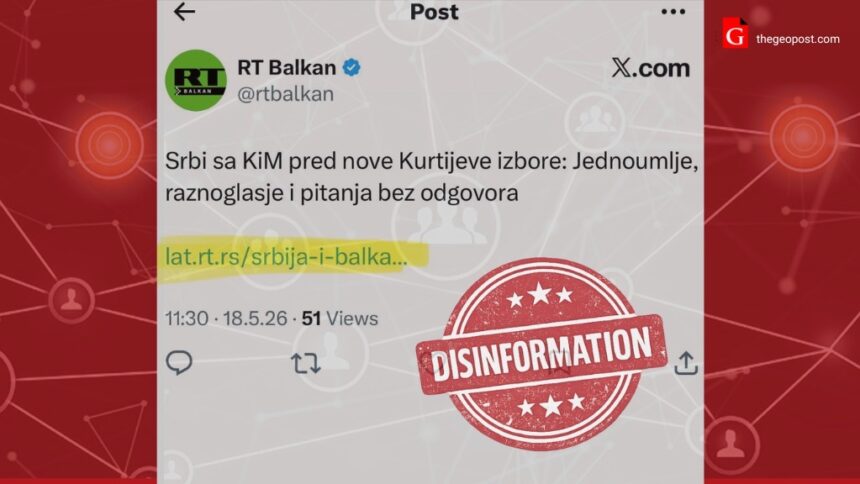
A toxic blend of militarized rhetoric and historical revisionism has resurfaced in regional media, as the Kremlin-backed outlet RT Balkan published a highly biased, emotionally charged article targeting the political climate in northern Kosovo.
The piece, titled “Serbs from Kosovo Ahead of Kurti’s New Elections: Single-mindedness, Polyphony, and Unanswered Questions,” has been flagged by independent disinformation monitors for systematically twisting local realities. Instead of providing objective pre-election journalism, the state-funded portal utilizes the upcoming June 7 national ballot as a pretext to breathe new life into dangerous, war-era narratives.
Deconstructing the Disinformation: The “Epic” Myth vs. Reality
The RT Balkan text functions less like a news report and more like an emotional political essay, deliberately designed to paint the international community and Kosovo’s state institutions as purely repressive actors.
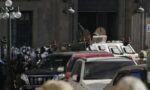
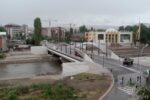
The article systematically distorts historical security crises in the north—specifically referencing the volatile barricades of 2011, 2021, and 2022—to build an artificial narrative of absolute victimization and continuous ethnic siege.
| RT Balkan Propaganda Quote | The Documented Reality |
| “The resistance of the Serbs was of epic proportions… triggered by conscience and moral imperative, not a party list.” | Coerced Mobilization: For years, residents of northern Kosovo have testified anonymously to independent watchdogs about severe social and political pressure. Citizens faced threats of isolation, job loss, and physical intimidation by parallel structures if they refused to man the barricades. |
| “In the rain, cold, and snow, people spent days, weeks, and months at the barricades… those days when the North was a free territory.” | Security Threat & Lawlessness: International bodies like NATO, KFOR, and the OSCE continuously warned that these barricades were not peaceful civilian protests. They were highly coordinated, armed political blockades that directly paralyzed freedom of movement and triggered severe security crises. |
| “How many people would go out into the night at the barricades today—with a knife, with a weapon, in resistance?” | Incitement to Violence: By openly invoking weapons and knives, the state media outlet actively crosses from journalism into the territory of radicalization and paramilitary incitement ahead of a democratic election. |
Erasing International Mandates and Border Accords
A core element of RT Balkan’s disinformation matrix is the branding of northern Kosovo during the blockades as a “free territory.” This narrative is engineered to foster the unlawful illusion that the north operates outside the jurisdiction of international agreements and sovereign state institutions.
In reality, the status of the northern border points—specifically Jarinje and Brnjak—has been a binding element of the European Union-facilitated dialogue between Pristina and Belgrade. Both capitals formally agreed to the implementation of Integrated Border Management (IBM), meaning the area was never a legal vacuum or an independent enclave, but a regulated border zone governed by international treaties.
   [THE PROPAGANDA MATRIX]
   Fabricate "Ethnic Siege" Narrative -> Erase EU/NATO Border Agreements -> Romanticize Lawlessness as "Freedom"
Systemic Omission of Paramilitary Violence
To maintain its strictly one-sided narrative of victimhood, the Russian state-media outlet completely sanitizes the history of the northern blockades. The text carefully omits a long, documented trail of localized violence directed at international peacekeepers, including:
- Armed skirmishes and targeted assaults against KFOR units trying to clear transit routes.
- Arson and bomb attacks directed at EULEX (European Union Rule of Law Mission) patrols and local border infrastructure.
- The documented operational presence of criminal networks and extremist groups acting under the direct guidance of Belgrade-backed parallel structures to enforce compliance through fear.
Conclusion: A Calculated Playbook to Deepen Ethnic Fractures
By attacking Kosovo’s political landscape as an “Albanian elite born from the terrorist mantle of the KLA,” RT Balkan relies on inflammatory, dehumanizing language rather than verified facts.
With national elections less than three weeks away, this reporting serves a distinct geopolitical purpose. It does not inform the public; rather, it aims to destabilize the region, deepen ethnic polarization, and provide ideological cover for undemocratic parallel systems that rely on fear and coercion to control the local Serb population.