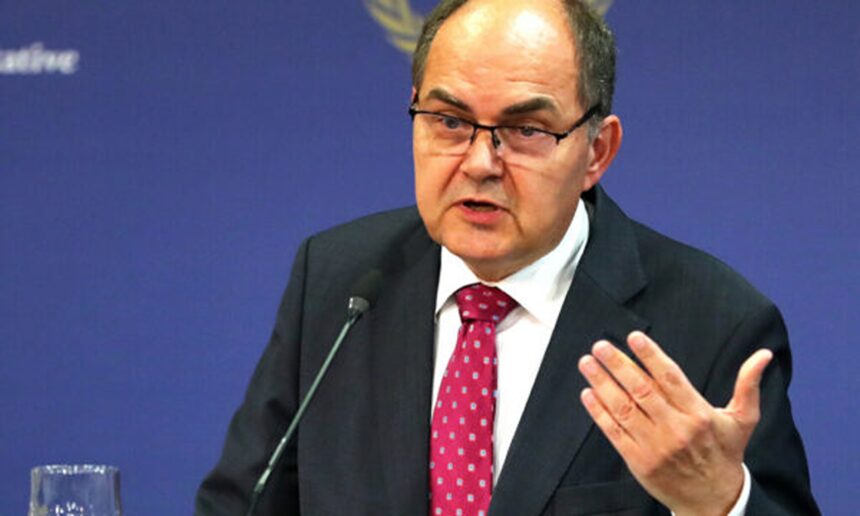
The outgoing High Representative Christian Schmidt said that Milorad Dodik had allocated millions of dollars for lobbying efforts aimed at removing him from office, adding that, in his view, the U.S. administration did not fully understand his approach to key political issues.
In an interview with RTL, Schmidt confirmed that he had been exposed to strong political pressure from the United States and announced the publication of a memoir in which he said he would further elaborate on the background of political developments, reports Net.hr.
When asked whether the U.S. administration had requested his removal due to the unresolved issue of state property, Schmidt said he believed certain actors did not understand his position.
“When it comes to state property, my approach is positive: the goal is to help solve problems, not create new ones. I would say some people have thought intensively about what and how to do this, but they may not have fully understood my position, which is constructive,” Schmidt said.
The issue of state property is also reportedly slowing down the implementation of the Southern Gas Interconnection project, a gas pipeline that is supposed to connect Bosnia and Herzegovina with the LNG terminal on the island of Krk.
The project was awarded without a public tender to a new U.S. company, AAFS Infrastructure and Energy LLC, supported by Jesse Binnall, a former lawyer of Donald Trump, and Joseph Flynn, the brother of former Trump adviser Michael Flynn.
According to available information, the company has no completed projects. Schmidt acknowledged that he was under strong pressure from the United States, but also claimed that Republika Srpska President Milorad Dodik had lobbied for his removal.
Reports suggest that Dodik’s multi-million-dollar lobbying efforts had an impact, as he, his family members, and close associates were subsequently removed from the U.S. sanctions list.
“I do not want people like Mr. Dodik to try to gain political advantage from elections, because there is no basis for that; the entire legal framework remains in force. What we should be working on is the Southern Interconnection, a project between Croatia and Bosnia and Herzegovina. That is well known,” Schmidt said.
The High Representative emphasized the importance of energy security in the region and supported continued implementation of the gas pipeline project.
“I would suggest that the European Union be supportive, including financing. I had a good conversation with Prime Minister Plenković about this, and I will stand on the side of those who want this project to succeed, whether it is an American or European initiative,” he said.
He also said that many people are looking forward to his memoirs.
“They will be more detailed and will say a bit more about how things really work,” he concluded.
He also noted that at the beginning of May, he confirmed before the United Nations Security Council that he would be leaving his position as High Representative for Bosnia and Herzegovina after a five-year mandate.