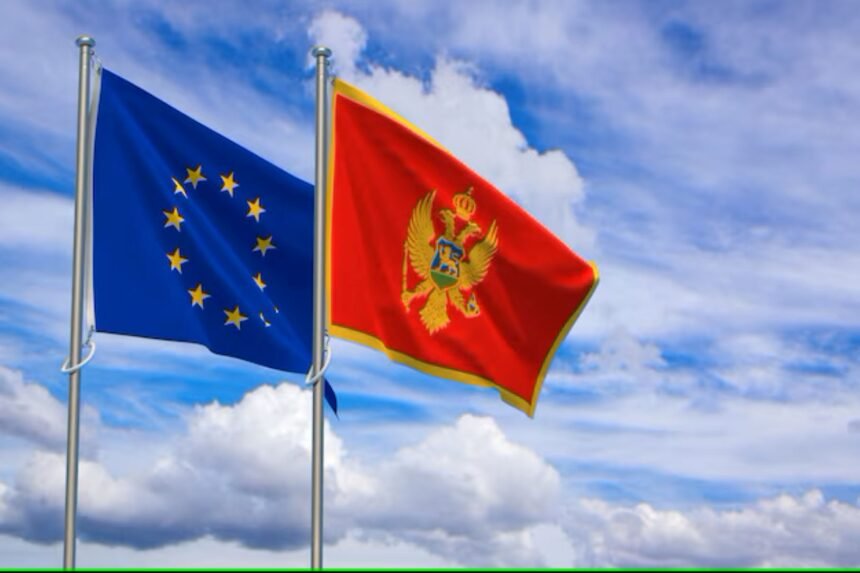
The European Commission has approved a massive financial package for Montenegro valued at nearly €3.2 billion. Alongside the recent decision to begin drafting the Accession Treaty, this move marks one of the most critical milestones in Montenegro’s path toward joining the European Union, representing concrete financial blueprinting for the country’s integration into the bloc.
“Today’s package is another tangible step toward Montenegro’s future in our Union. We are preparing Montenegro, our member states, and our institutions, because enlargement succeeds only when it is a joint European project, built on merit, commitment, and trust,” stated European Commission President Ursula von der Leyen.
European Commissioner for Enlargement Marta Kos emphasized that the package fulfills EU commitments as Montenegro continues its domestic reforms. The goal is to ensure a seamless administrative and financial transition, allowing Montenegro to fully participate in the EU budget and policies from day one of full membership.
Projections Base Accession on 2028 Timeline
The financial package is tightly aligned with the proposal for the EU’s next seven-year budget cycle spanning 2028–2034. All calculations are mathematically modeled under the explicit assumption that Montenegro will become an official EU member state in 2028.
The document is a core component of negotiations under Chapter 33 (Financial and Budgetary Provisions), which dictates how a new member state contributes to and draws from the shared EU budget. It has already been forwarded to the Council of the European Union to serve as the baseline for upcoming negotiations with Podgorica.
Diplomatic sources note that integrating Montenegro will carry a minimal financial impact on existing member states, unofficially calculated to cost EU citizens less than one euro per capita annually.
Strong Political Signals and Budgetary Continuity
Montenegro stands out as the only candidate country included in this long-term budgetary forecast, a detail local officials view as an immense diplomatic victory.
“This constitutes a powerful political signal that the European Union views us as its next member,” Montenegro’s Minister for European Affairs, Maida Gorcevic, told Radio Free Europe.
Gorcevic explained that by planning these allocations now, the EU ensures that the transition from pre-accession assistance (IPA) to regular EU structural funds will happen smoothly without halting ongoing development and reform projects.
“This planning proves that the European Union is not just preparing for the continuation of negotiations with Montenegro, but for its successful accession, recognizing the concrete reform results achieved by this government,” Gorcevic added.
Allocation of the €3.2 Billion Fund
According to the European Commission’s blueprint, the seven-year budgetary framework will distribute funding to Montenegro across several key pillars:
| Allocation Pathway | Allocated Amount |
| National and Regional Partnership Plan | €1.99 Billion |
| Common Agricultural Policy (CAP) | €277 Million |
| Internal Affairs Programs | €592 Million |
| Interreg Cross-Border Cooperation | €37 Million |
Note: Additional funding will be drawn from various other internal and external EU programs.
Revitalizing EU Enlargement Policy
Independent experts view the minimal cost of Montenegro’s entry as a strategic template for the broader region.
“This package clearly demonstrates how small the cost is to the European Union for the accession of not only Montenegro, but other Western Balkan countries as well,” Peter Zherjavic, Brussels correspondent for the Slovenian newspaper Delo, told Radio Free Europe.
Invoking the major 2004 expansion when ten countries joined the bloc simultaneously, Zherjavic noted that Montenegro’s entry could trigger massive economic growth via EU funding while firmly anchoring the nation within the Western political and security sphere.
Montenegro remains the most advanced candidate country in the entire integration process, having temporarily closed 16 out of 33 negotiating chapters. Authorities in Podgorica expect to formally conclude all membership negotiations by the end of this year, clearing the path to officially become the 28th member state of the European Union in 2028.