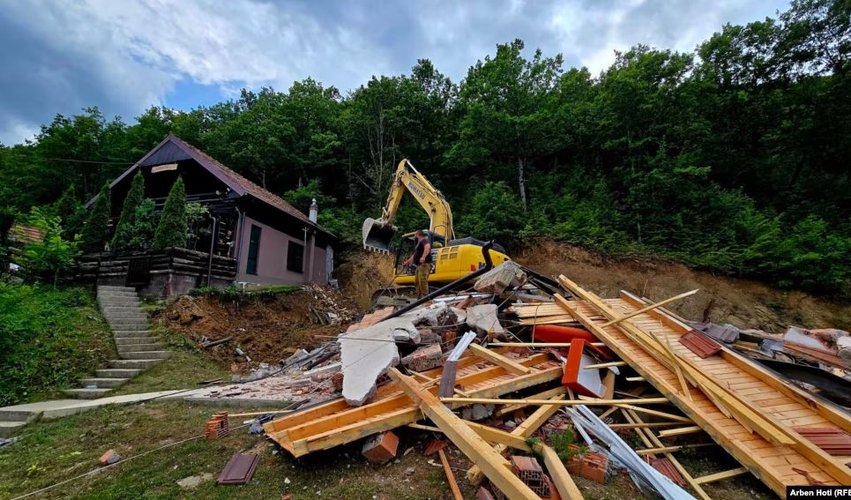
The demolition of 11 houses near Lake Ujman (Gazivoda) in northern Kosovo continues to fuel debate over the balance between protecting public property, respecting legal procedures, and avoiding ethnic or political interpretations of law enforcement.
Kosovo authorities began demolishing the structures on Tuesday, stating that the buildings were constructed without permits on public property managed by the Hydro-Economic Public Enterprise “Ibër-Lepenc.”
The operation, carried out with the assistance of Kosovo Police, has drawn criticism from property owners and concern from international actors, including the European Union, Germany, and the United Kingdom, who called for respect for legal procedures and due process.
Faruk Mujka, chief executive of “Ibër-Lepenc,” said that the plots where the buildings were constructed have belonged to the company since 1973, following the expropriation process linked to the construction of Lake Ujman.
He emphasized that actions to protect public property would continue in all cases of illegal occupation or unauthorized construction, regardless of the ethnic background of those involved.
“Public property must be protected, and the law must apply equally to everyone,” Mujka said.
Experts: Illegal construction creates a dangerous precedent
Security expert Adem Lushaj told “Bota sot” that the demolitions should primarily be viewed through the perspective of rule of law and protection of public property, rather than through an ethnic or political lens.
“If institutions acted in accordance with the law and after regular procedures were completed, then this represents the fulfillment of state obligations and should not be judged based on ethnic affiliation or political interests,” Lushaj said.
He added that while international concerns about maintaining stability are understandable, long-term stability can only be achieved through equal enforcement of the law across all of Kosovo.
“The law must be implemented equally in every part of Kosovo. Stability cannot be built by tolerating violations,” he said.
Lushaj argued that the case should also serve as an example for addressing illegal construction in other protected areas, including the Accursed Mountains and the Šar Mountains, where unauthorized construction and environmental damage have also been reported.
Analysts warn against perceptions of selective justice
Political analyst Zejnullah Jakupi said the demolition of illegal structures can be justified if authorities acted according to legal procedures, but stressed that institutions must guarantee transparency and equal treatment.
“Any construction without a permit on public property creates a dangerous precedent because it weakens respect for the law and harms the public interest,” Jakupi said.
However, he warned that authorities must avoid creating the perception that laws are being applied selectively or for political purposes, particularly in sensitive areas such as northern Kosovo.
“Every action must be accompanied by institutional care, transparency, and clear communication,” he said.
Regarding the EU’s reaction, Jakupi said it should not be interpreted as opposition to the rule of law, but rather as a call for caution, coordination, and respect for legal guarantees.
“The protection of public property and respect for citizens’ rights must go hand in hand,” he said.
International concerns and political interpretations
The EU Office in Kosovo expressed concern over the demolitions, calling on authorities to suspend further actions until questions related to legal procedures, proportionality, property rights, and effective legal remedies were clarified.
The German and British embassies in Prishtinë also raised concerns over whether proper procedures had been followed.
The reactions have become part of a wider political debate, with Serbian representatives arguing that the demolitions target the Serbian community, while Kosovo authorities insist the issue concerns illegal construction and protection of public assets.
Critics of the Serbian political narrative argue that the controversy is also being used for political messaging, with claims of discrimination raised selectively when actions affect Serbian-owned properties, while the broader issue of illegal construction and public land protection is framed differently depending on political interests.
Supporters of the Kosovo authorities say the principle should remain simple: illegal construction on public property must be addressed regardless of who built it.
The ongoing dispute highlights the challenge facing Kosovo institutions: enforcing the law in a sensitive region while ensuring transparency, equal treatment, and public confidence.