Kosovo’s acting Prime Minister Albin Kurti has warned that Serbia’s expanding military capabilities are not simply part of an effort to modernize its armed forces, but instead form part of a broader political and diplomatic strategy that he linked directly to Belgrade’s alleged hegemonic ambitions in the region, particularly toward Kosovo.
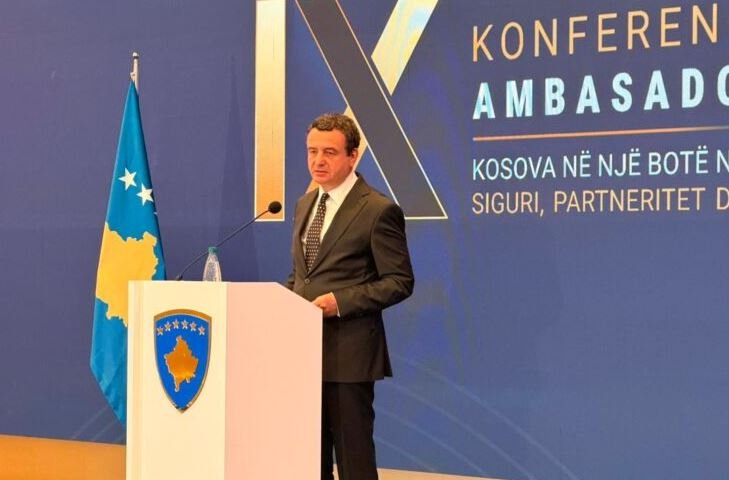
Speaking at the ninth Conference of Ambassadors of the Republic of Kosovo, Kurti said geopolitical developments and Russia’s growing influence in the Western Balkans had increased security sensitivities across the region.
“Serbia’s expansion of its military capabilities is not simply an effort to modernize its army, but a broader political and diplomatic strategy directly linked to its hegemonic ambitions toward our region, and particularly Kosovo,” Kurti said.
He argued that the continued rhetoric of Serbian leaders demonstrated what he described as the persistence of Serbia’s expansionist claims in the region, accompanied by calls for further strengthening military capabilities.
Kurti said Kosovo had chosen a different path, focused on strengthening democratic institutions, expanding security capabilities and deepening international partnerships.
“For Kosovo, this means continuing our partnership with the United States and other allies who share the same values and remain committed to maintaining a rules-based international order,” he said.
He described Kosovo’s partnership with NATO and its participation in various cooperation programs with the alliance as key pillars in consolidating the country’s security capabilities.
According to Kurti, NATO’s presence and role in Kosovo and the wider region remain crucial to maintaining regional stability.
The acting prime minister also warned about the broader security implications of Russia’s influence in the Western Balkans, arguing that the war in Ukraine had fundamentally changed assumptions about peace and stability that had prevailed since the end of the Cold War.
“Since Russia’s aggression against Ukraine, the assumptions about peace and stability built after the end of the Cold War no longer hold,” Kurti said.
He pointed to Russia’s use of military force, cyber capabilities, disinformation campaigns and political influence as examples of how modern conflicts increasingly extend beyond conventional battlefields.
“Coordinated campaigns of disinformation, propaganda and information manipulation make your work as ambassadors more difficult,” he told Kosovo’s diplomats.
Kurti urged Kosovo’s diplomatic representatives to be better prepared to counter false narratives and foreign interference in the information environment.
“Diplomats today must deal with information management, combating disinformation and maintaining public trust,” he said, stressing that false narratives should be challenged through fact-based communication and real-time engagement with civil society and other non-state actors on digital platforms.
His remarks come amid heightened security concerns in the Western Balkans, where Serbia’s military modernization, its defense cooperation with Russia and China, and continued tensions with Kosovo remain major issues for regional security and Western policymakers.