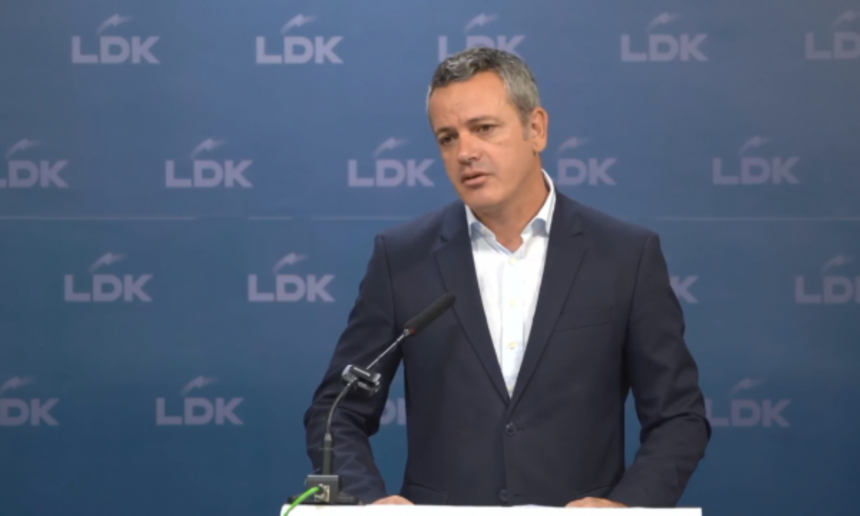
Kosovo’s political deadlock over the constitution of the Assembly has intensified after Democratic League of Kosovo (LDK) MP Arben Gashi accused Prime Minister Albin Kurti and the Vetëvendosje Movement (VV) of deliberately delaying the formation of state institutions for electoral gain.
In a lengthy statement published on Facebook, Gashi argued that if Kurti truly has the 62 votes he claims to have for both the election of the Assembly speaker and the formation of a government, there is no reason for the Assembly to remain blocked.
“Albin Kurti says he has 62 votes to constitute the Assembly. He also says he has 62 votes to form the government. Then the unavoidable question is: If you have the votes, why don’t you constitute the Assembly?” Gashi wrote.
“If you have the votes, vote. If you have the majority, govern. If you have the mandate, take responsibility.”
Gashi argued that the continued failure to constitute the Assembly cannot simply be explained by a lack of numbers, but instead reflects a political choice.
He accused VV of following a strategy of “block, gain time” in order to delay the formation of institutions and potentially create conditions for new parliamentary elections.
“If the formula is: block, gain time, delay institutions, go to elections and seek more power, then this is no longer a procedural disagreement. It is a political strategy,” Gashi said.
He also questioned the repeated calls for potential constitutional challenges, arguing that new proceedings before the Constitutional Court would not resolve the institutional impasse but could instead prolong it.
“A new case does not make the Assembly functional. It delays it,” Gashi wrote, adding that time in politics is not neutral.
According to Gashi, continued delays could affect not only the constitution of the Assembly and formation of the government, but also the subsequent process of electing Kosovo’s president and potentially bring the country closer to new elections.
He questioned whether the political objective was genuinely to make the Republic’s institutions functional or to create the conditions for another election in which Kurti could seek a stronger mandate.
Gashi offers LDK votes
Gashi said LDK should remain constructive in the ongoing crisis, but warned that the opposition should not be naïve.
He went further by offering LDK’s votes to enable the constitution of the Assembly if VV does not have the necessary support.
“You have 62 votes? Constitute the Assembly. If you don’t, we will give you our votes. Propose whoever you want for Assembly speaker,” Gashi wrote.
He added that the formation of a government should likewise proceed if Kurti has the necessary majority, while the issue of electing a consensual and non-partisan president could be addressed at a later stage.
“For the president, we can talk about a consensual and non-partisan candidate when that point comes,” he said.
Gashi also criticized what he described as political calculations surrounding the diaspora, arguing that Kosovo’s diaspora deserves respect but that political commitment to the diaspora should be demonstrated through responsibility toward the state rather than symbolism.
“The Assembly must function. The state does not function through propaganda. The state functions through institutions,” he wrote.
Opposition urged to build an alternative
Gashi also assessed the positions of Kosovo’s opposition parties, arguing that LDK should not simply copy Kurti’s confrontational political style.
He said the Democratic Party of Kosovo (PDK) was waiting for September, when the potential return of three Kosovo leaders from The Hague could significantly alter the political landscape.
He also described the Alliance for the Future of Kosovo (AAK) as pursuing a more direct confrontation with Kurti, including tactics that Kurti himself had previously used.
“Opposition parties should not copy Kurti. They should build an alternative that is stronger than Kurti,” Gashi said.
According to Gashi, Kurti cannot ultimately be removed through political chaos but through democratic competition.
“Kurti is not removed by chaos. He is removed by democracy,” he wrote.
He called for stronger political organization, leadership and public engagement, arguing that voters should ultimately decide whether the current political approach deserves another mandate.
“The Republic must not be held hostage”
Gashi concluded by warning against using institutional paralysis as an electoral strategy.
“Do not hold the Republic hostage for an electoral calculation,” he wrote.
“If the choice is to keep the state dysfunctional in order to produce new elections and seek even more power, then this is no longer a battle for a mandate. It is a battle for control of the state.”
He said Kosovo’s citizens and diaspora would ultimately have the final say through their votes.
“Votes are not a blank cheque. A vote is trust. A vote is responsibility. And a vote is also punishment when power forgets the Republic.”
Gashi ended his statement with a call for stronger institutions rather than greater concentration of power:
“More Republic. Less personal power. More institutions. Less propaganda. More democracy. More leadership.”
“Powers change. Mandates end. The Republic remains.”